This is the third essay in the Define The AI Agent Lifecycle series. The first argued that execution is not delivery — AI Agent work needs a lifecycle. The second argued that more agents are not MAS (Multi-Agent Systems) — multi-agent work needs lifecycle responsibility separation. This essay enters the third layer: Orchestration Is Not Delivery.
My initial assumption: the Orchestrator is just a coordinator
SoloCrew started from a very concrete requirement: one person managing multiple projects simultaneously, needing a system that lets every project genuinely deliver — not just run.
In that design, I call each project a Cell. When one person runs multiple Cells at once, the first thing that needs to appear is not an execution Agent, but a Secretary role. This Secretary is not a generic chat assistant — it helps me organize each project’s requirements, goals, current state, priorities, and acceptance criteria, translating my intent as a human into structure the system can work with.
But the Secretary is not the execution authority for each project.
Each Cell also needs its own CEO. This CEO is not a simulation of a traditional job title, not a specific executor — it is the node inside each project unit genuinely responsible for goal decomposition, Role activation, task boundary definition, evidence convergence, and delivery outcome. I define this CEO role as the Orchestrator.
My initial understanding was intuitive. It is a coordinator. It knows which Agent should run first, which Agent handles which tool call, how to pass one Agent’s output to the next. Like a dispatcher — no need to complete tasks directly, just route them to the right place.
This picture was sufficient at first.
But as projects became genuinely complex — as the Orchestrator was no longer just routing a fixed sequence of steps, but needed to decide what the project goal is, how to decompose work, which tasks go to which roles, and finally how to judge whether work is complete — this picture started to break.
The problem was not at the execution layer. It was somewhere earlier:
If the Orchestrator is responsible for decomposing project goals, it is shaping the entire direction of the project. If it assigns tasks, it is deciding which role bears which responsibility. If it converges results, it is judging what counts as done and what does not.
These are not “scheduling.”
This is project authority.
So: who monitors the Orchestrator?
The authority and oversight gap
I cannot skip over this question.
When a system has a node responsible for decomposing goals, distributing work, and adjudicating results — it is no longer a router. It is a decision layer.
The danger of a decision layer is not that it will produce bugs. It is that, without checks, it forms single-point semantic judgment:
It decides what the project goal means. It decides which task belongs to which role. It decides whether a piece of evidence is sufficient. It decides whether a result enters accepted state.
Every one of those judgments has consequences. Every one of them should be challengeable, traceable, convergeable.
But in most Orchestrator designs today, these judgments are made at a single point.
Single-point judgment is not a temporary problem. It is a structural problem.
An Orchestrator holding this much authority with no corresponding oversight structure — this is the most fundamental gap between a delivery-grade orchestrator and an ordinary orchestrator in the AI Agent Lifecycle.
Before answering “what should an Orchestrator become,” I need to establish a judgment framework. That framework cannot start from the Orchestrator’s capabilities. It must start from delivery itself.
Bidirectional mapping: the source of delivery determinism
When designing the SoloCrew Cell CEO, bidirectional mapping as a structure emerged from a very concrete problem: the CEO must be accountable to the project in two directions.
Downward, it needs to decompose my intent as a human user into structure that Agent Roles can execute. Upward, it needs to translate execution results, evidence, risks, and boundary changes back into delivery state that I can accept.
If it can only execute downward, I will never know whether a piece of work is truly complete.
If it can only report upward, the execution process has no accountability constraints.
Missing either direction, a project cannot genuinely close.
This is where bidirectional mapping comes from.
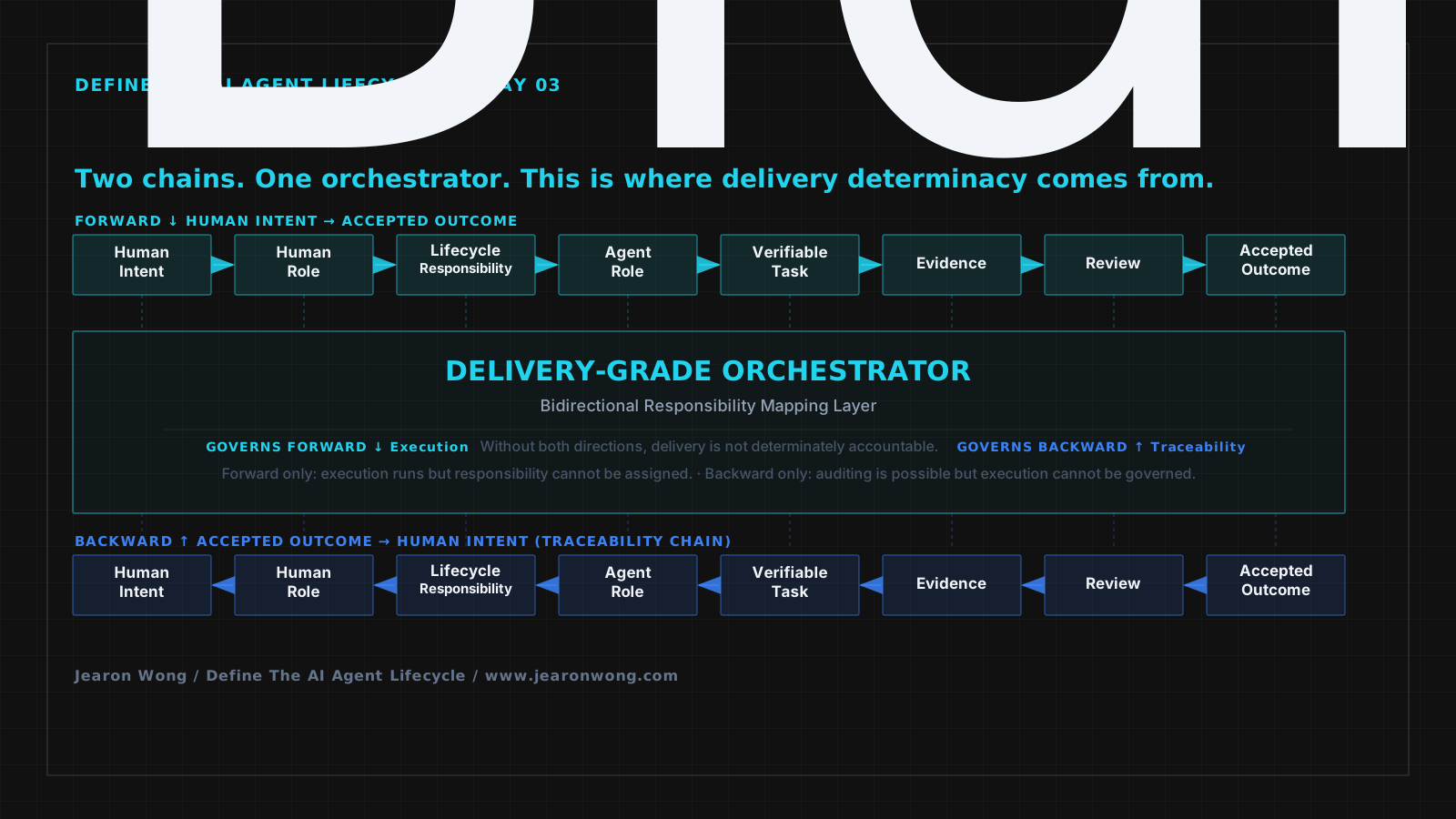
Delivery is not execution completion.
Delivery is this:
Human Intent, translated into responsibility definitions under Human Roles. Human Roles mapped into Lifecycle Responsibility: who is responsible for what, within which boundary. Lifecycle Responsibility translated into Agent Roles — not directly pasting human job titles onto Agents. Every task executed by an Agent Role must produce Evidence. Evidence must pass Review. Only after Review is there a possibility of entering Accepted Outcome.
This is the forward chain.
But delivery also requires the backward chain: from Accepted Outcome, tracing back through Accepted Outcome → Review → Evidence → Verifiable Task / Agent Role → Lifecycle Responsibility → Human Role → Human Intent.
The backward chain is the foundation of accountability. If delivery goes wrong, you must be able to trace from the accepted result back to human intent: who proposed this work, who defined its responsibility boundary, which Agent Role executed it, what evidence it produced, who reviewed that evidence, and under what conditions it entered accepted state.
With only the forward chain, the system can execute — but cannot assign responsibility.
With only the backward chain, the system can audit — but cannot govern execution.
A delivery-grade Orchestrator must maintain both directions simultaneously.
This is not the result of a more powerful model, more agents, or more complex workflows. This is what becomes possible only when human responsibility and agent lifecycle responsibility are locked into the same verifiable delivery relationship.
This is the source of project delivery determinism.
Once you accept this framework, the limitations of an ordinary Orchestrator become clear: it coordinates execution, but it was not designed to maintain this bidirectional mapping. It knows what runs first, but not who is responsible for that run; it knows that work completed, but not whether “completed” equals “delivered.”
Agent orchestration coordinates execution. It does not define delivery.
The Orchestrator cannot be a single point: why a consensus layer is necessary
Accepting bidirectional mapping as the core responsibility of a delivery-grade Orchestrator, the next question follows immediately:
Who ensures this mapping is correctly maintained?
An Orchestrator has three categories of core judgments to make:
The first is coordination judgment: how should goals be decomposed, how should work be organized, who should tasks be assigned to, what is the execution path.
The second is authority/risk judgment: is this operation within authorized scope, has it triggered a risk boundary, does it require human confirmation, has a boundary violation occurred.
The third is evidence/acceptance judgment: is this batch of evidence sufficient, is the result reviewable, has it reached the accepted condition.
These three categories have different natures. The same judgment subject easily generates tension between “coordination urgency” and “risk compliance”: wanting to push work forward while needing to halt boundary violations; wanting to converge results while needing to objectively assess whether evidence is genuinely sufficient.
Concentrating these three judgment categories in a single Orchestrator is the beginning of three perspectives consuming each other.
This is not because a single Orchestrator is insufficiently capable. It is because single-point semantic judgment is structurally unaccountable.
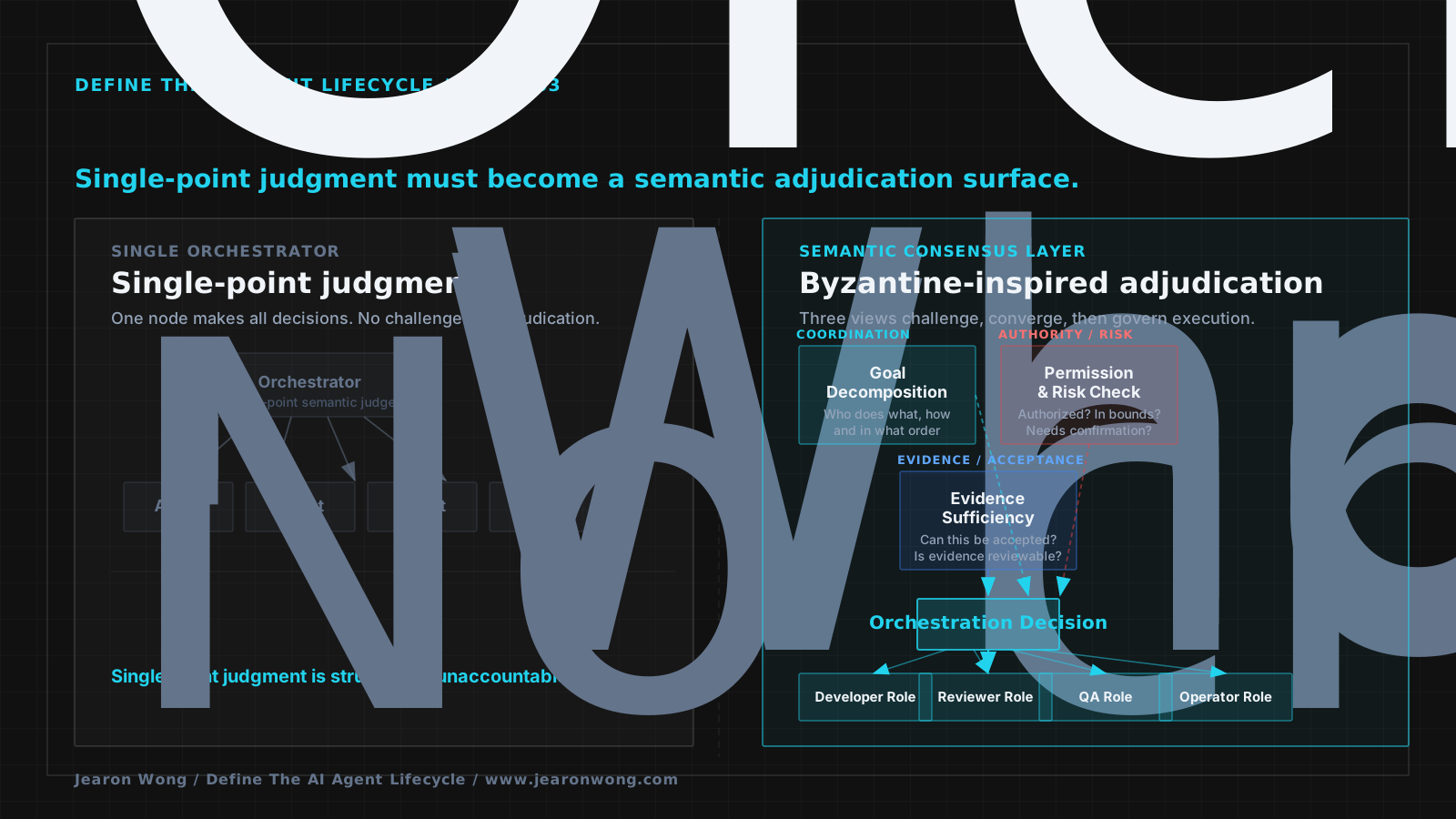
A delivery-grade Orchestrator needs a semantic consensus surface, not a single-point decision maker.
This is not a traditional Byzantine fault-tolerance algorithm, not a BFT protocol from distributed systems. It is closer to Byzantine-inspired semantic consensus: single-point semantic judgment cannot be trusted; critical project decisions must pass through challenge and convergence from multiple perspectives.
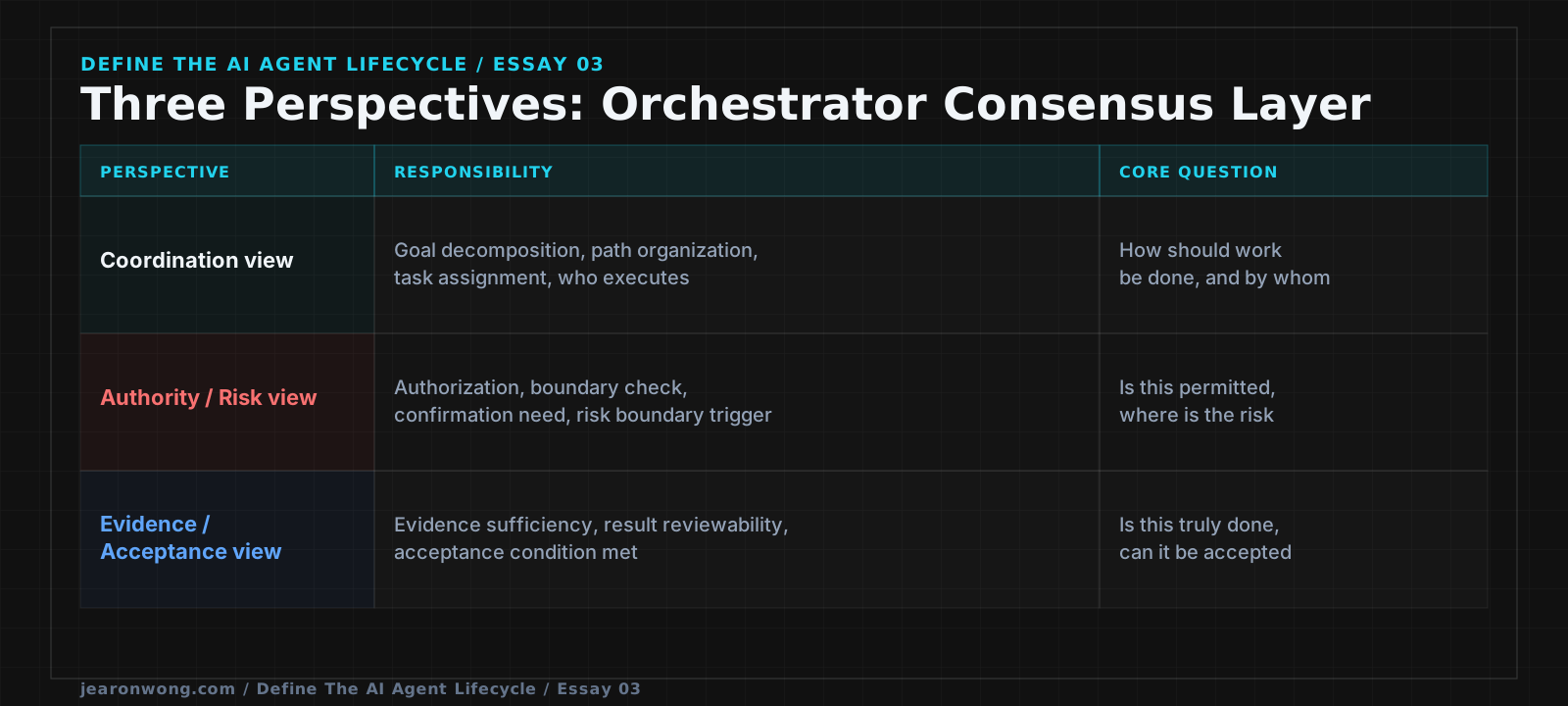
These three perspectives challenge each other: Coordination view wants to push forward, Authority/Risk view wants to halt boundary violations, Evidence/Acceptance view wants to confirm evidence is sufficient. The convergence of three perspectives is the real Orchestration Decision.
Take the payment failure retry scenario: midway through the development phase, Developer Role discovers that the original design would produce state inconsistency on network timeout, and wants to extend the implementation by writing retry state into the subscription model for persistence.
Coordination view judges this a reasonable implementation choice and approves proceeding. Authority / Risk view finds that writing to the subscription model crosses a module boundary not confirmed by Architect Role. Evidence / Acceptance view determines there is no scope authorization record in the current evidence chain supporting this change.
The three perspectives do not converge. The Orchestrator should not choose to continue — it should pause execution, trigger Architecture Confirmation, write this boundary conflict into the evidence chain, and wait for a human role to confirm the new scope of change.
This is the value of the consensus layer: not to make decisions faster, but to prevent critical boundary judgments from being swept past by a single execution perspective.
The implementation choices belong to the Runtime layer: whether three Agents form a governance committee, a policy-based adjudication mechanism, or a hybrid of deterministic gates with LLM judgment — all are valid. But regardless of implementation, the structural requirement is the same:
Single-point semantic judgment cannot be trusted.
This is a challengeable, traceable, convergeable semantic adjudication layer — not an execution router.
Agent is the executor; Role is the responsibility unit
Once the Orchestrator bears bidirectional mapping, what it manages is not a fixed Agent list, but a Role Graph that changes dynamically with project pressure.
A critical distinction must be made clear:
Agent is the executor. Role is the responsibility unit.
An Agent is the technical execution node — it calls tools, generates output, performs operations. A Role is the lifecycle responsibility boundary — it defines who is responsible for what, within which scope, what they are permitted to do, what evidence they must produce, and who accepts the result.
A Role is not a label copied from human job titles. Tagging an Agent “Developer” or “Reviewer” does not give that Agent the corresponding responsibility structure. Role is the unit that truly bears responsibility in the system.
A Role definition must include the following fields:
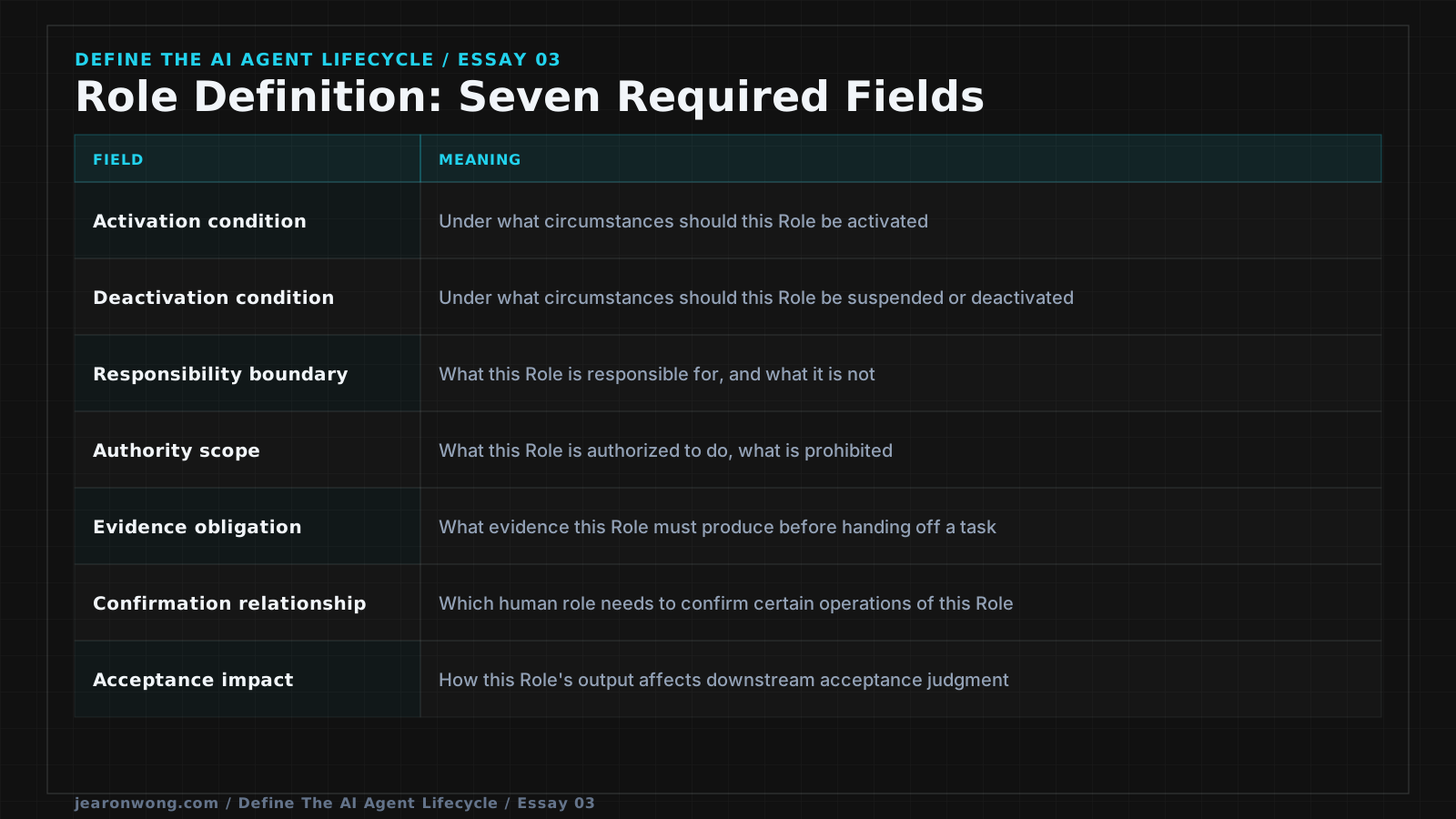
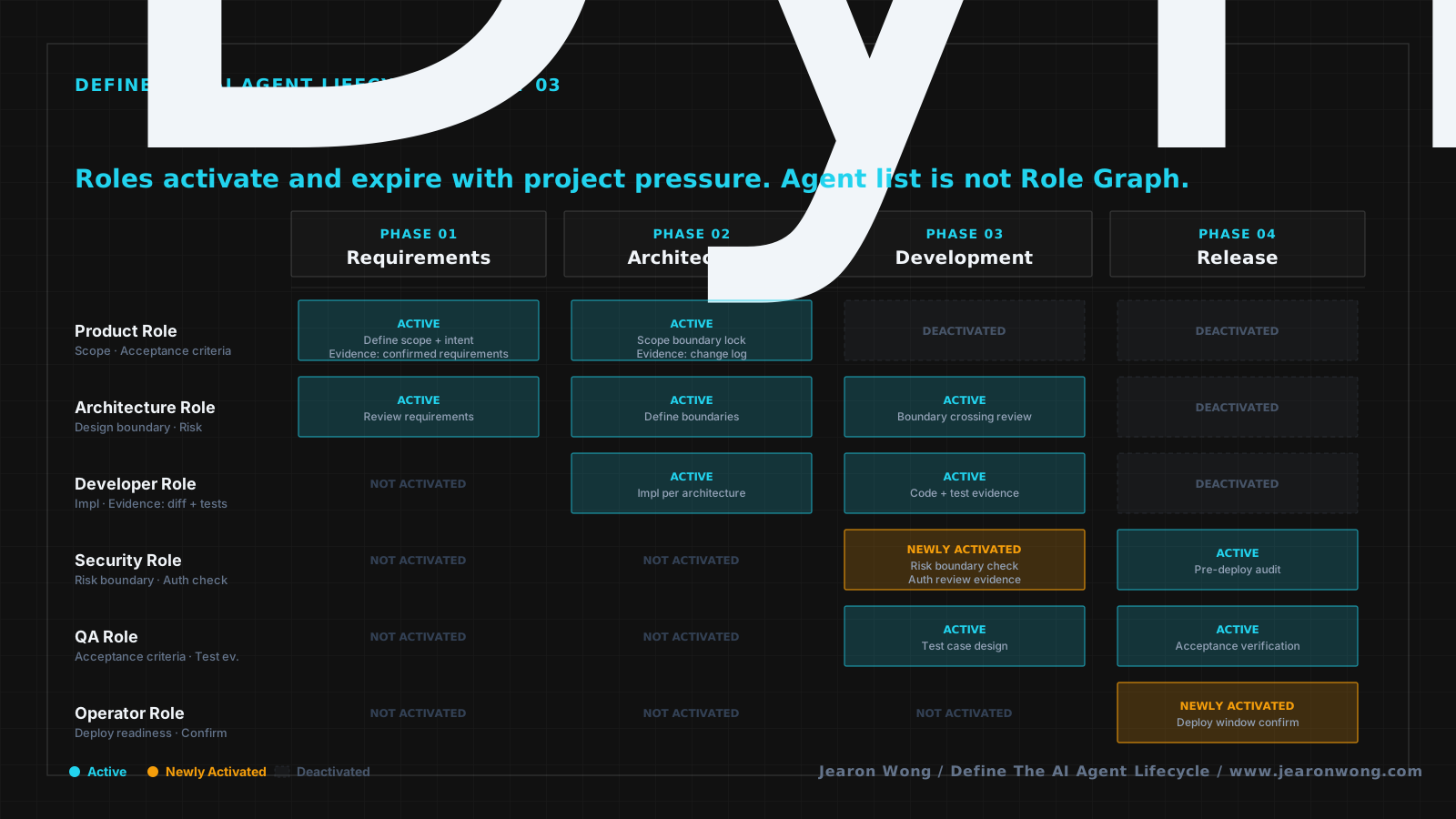
These fields are not optional decorations. Without them, a Role is just a name. With them, a Role is a responsibility unit that can be activated, monitored, adjusted, and deactivated by the Orchestrator.
The Role Graph is dynamic.
The project enters requirements confirmation, activating Product Role and Architecture Role. Entering development, activating Developer Role and Reviewer Role. Encountering security-related changes, activating Security Role. Entering release, activating QA Role and Operator Role. When requirements are overturned, certain Roles suspend pending reconfirmation. When a phase completes, certain Roles’ missions are finished and should be explicitly deactivated.
Deactivation is not optional. Expired Roles left in the system’s semantic state create new Semantic Loss: the system continues referencing a responsibility structure that is no longer applicable, producing judgments that appear reasonable but correspond to the wrong lifecycle phase.
Dynamic Role Graph management — activation, adjustment, suspension, deactivation — is one of the structural responsibilities of a delivery-grade Orchestrator, not a detail to be ignored at runtime.
A task is not dispatch — it is a verifiable objective
The existence of Roles fundamentally changes the nature of task distribution.
An ordinary Orchestrator dispatches like this:
Developer Agent, go write the payment failure retry module.
This is an action item. Once executed, pass to the next node, continue.
A delivery-grade Orchestrator must dispatch like this:
Developer Role, in the current project’s payment reliability phase, within the following responsibility boundaries: permitted to modify retry logic in PaymentService, not permitted to modify billing logic in OrderService, not permitted to introduce a new third-party payment gateway. Must produce: unit test coverage > 80%, state transition documentation for retry logic, and handling explanation for three failure scenarios (network timeout, payment gateway rejection, insufficient account balance). Architect Role confirms whether boundaries were observed; QA Role verifies test results; Tech Lead human role accepts the final merge. If rejected by Reviewer Role: roll back code state to the current architecture snapshot, record rejection reason and related evidence into the evidence chain, restart execution only after Architect Role reconfirms the scope of change.
The gap between these two is the gap between execution dispatch and lifecycle-bound verifiable objective.
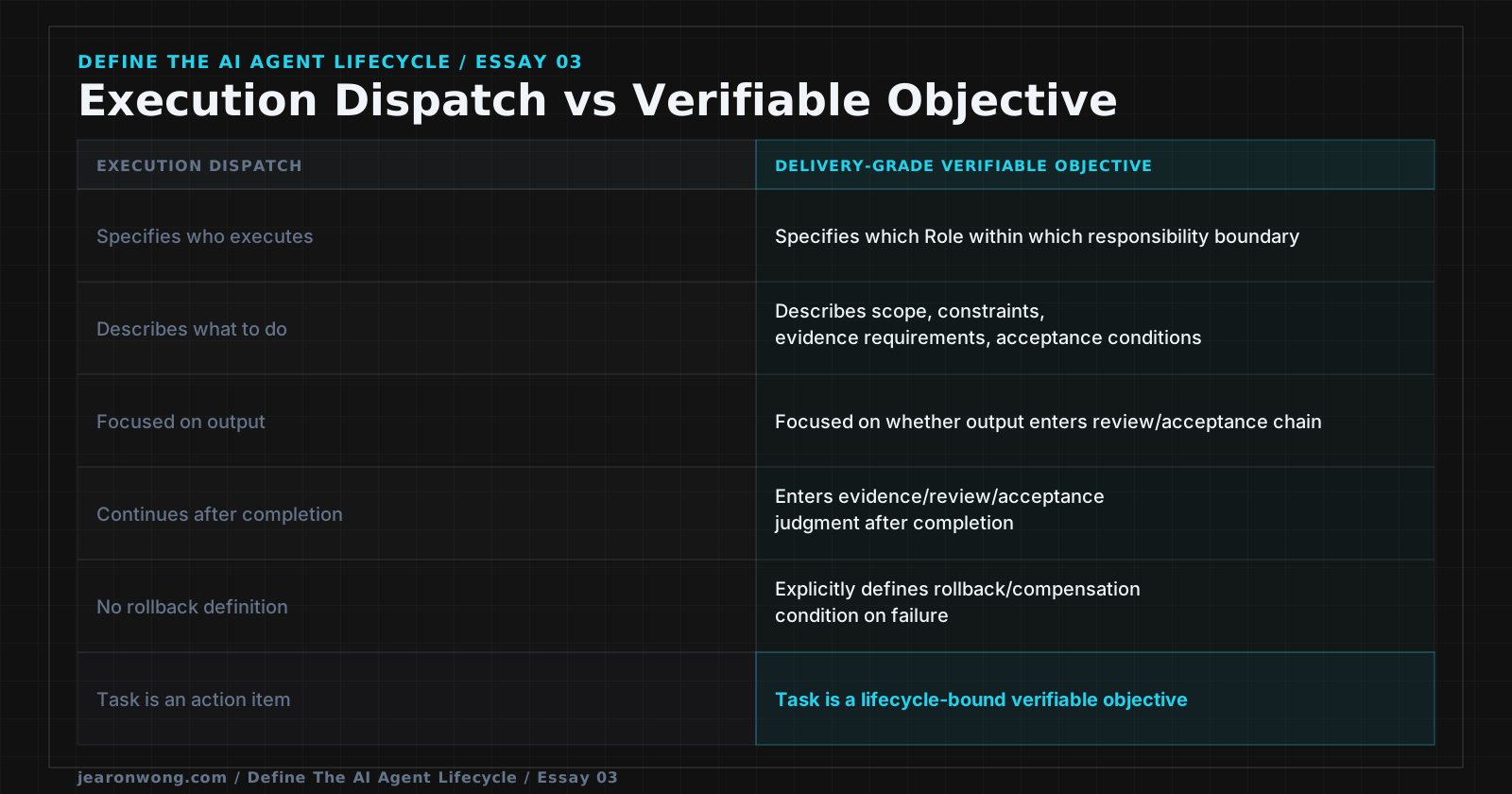
A delivery-grade task must define not just how to complete it, but how to roll back on failure and who confirms compensation is complete.
A task is not an action item. It is a lifecycle-bound verifiable objective. This transformation is the most concrete gap between a delivery-grade Orchestrator and an ordinary Orchestrator at the task management layer.
HITL is not a button — it is responsibility returning through a human role
Ordinary Human-in-the-Loop works like this: Agent executes, human Approves or Rejects, then continue.
This is not governance. This is a checkpoint.
This checkpoint tells us “a human clicked a button in the process” — but not: what role the human was confirming in, what scope they confirmed, what downstream authority this locked, what traceable accountability record it produced.
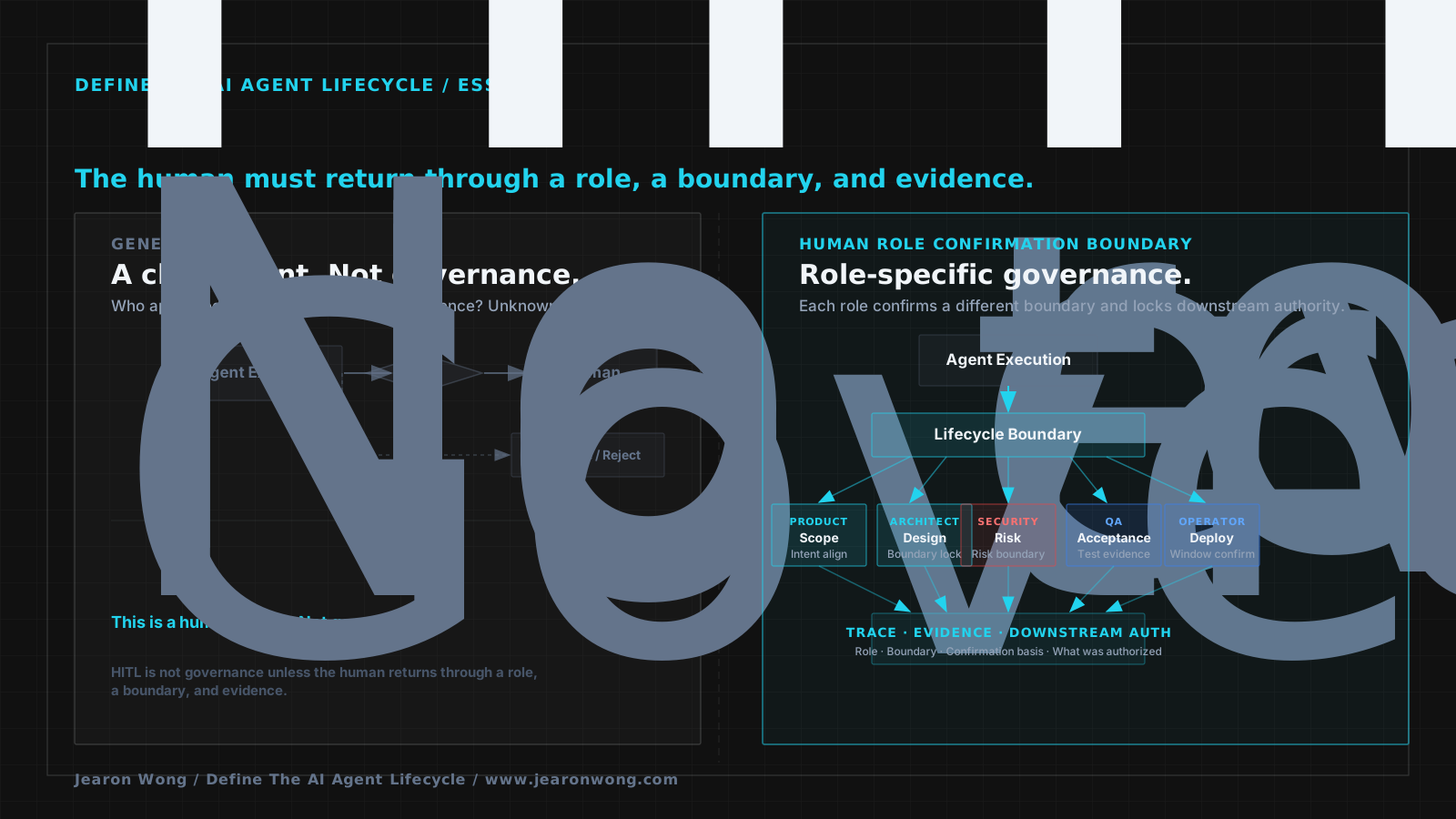
Governance requires not a human button, but a Human Role Confirmation Boundary.
In the AI Agent Lifecycle, different human roles confirm different content at different boundaries:
Product Role confirms whether the requirement scope is correctly understood and aligned with original intent. This confirmation locks the requirement boundary, authorizing subsequent architecture and development work to proceed on this basis.
Architect Role confirms whether the implementation plan is within design boundaries, and whether cross-module dependencies are authorized. This confirmation locks the implementation path; development crossing this boundary triggers a boundary violation event.
Security Role confirms whether the operation touches a risk boundary, and whether additional security review is required. This confirmation either unlocks subsequent operation authority or explicitly blocks the operation.
QA Role confirms whether test coverage meets acceptance criteria, and whether the result can enter accepted state. This confirmation is the final technical gate before output enters the delivery chain.
Operator Role confirms whether deployment conditions are met and whether the current time is within the correct operational window. This confirmation is the final authorization from accepted to delivered.
Every human role confirmation should produce: confirmation scope (what this confirmation covers), confirmation basis (what evidence it is based on), downstream authorization (which Agents can continue, which are blocked), traceable record (this confirmation enters the evidence chain).
HITL is not governance unless the human returns through a role, a boundary, and evidence.
Ordinary HITL can only say “someone looked at this.” Human Role Confirmation Boundary can say “who, within what scope, based on what evidence, made what commitment, and bears what responsibility.”
The latter is what the “Human Role” node in bidirectional mapping should truly do.
Three semantic planes and the true source of Semantic Loss
Once the Orchestrator bears bidirectional mapping, a new problem immediately emerges:
Which confirmation corresponds to which human role? Which piece of evidence belongs to which Agent Role? Which learning feedback belongs to the project layer? The role layer? The operator layer?
If the Orchestrator cannot distinguish these, it cannot truly maintain bidirectional mapping. It mixes state from different layers, producing judgments that appear to have answers but have answered the wrong question.
This is the concrete form of Semantic Loss at the Orchestrator layer.
Not that the context is too long — but: a project-layer judgment resolved with operator-layer preferences; a role-layer boundary check disrupted by project-layer urgency; an operator’s confirmation treated as scope authorization when it was actually only a deployment confirmation.
Each layer has different truth, serving different questions. Flattening them produces answers that are formally complete but semantically misaligned.
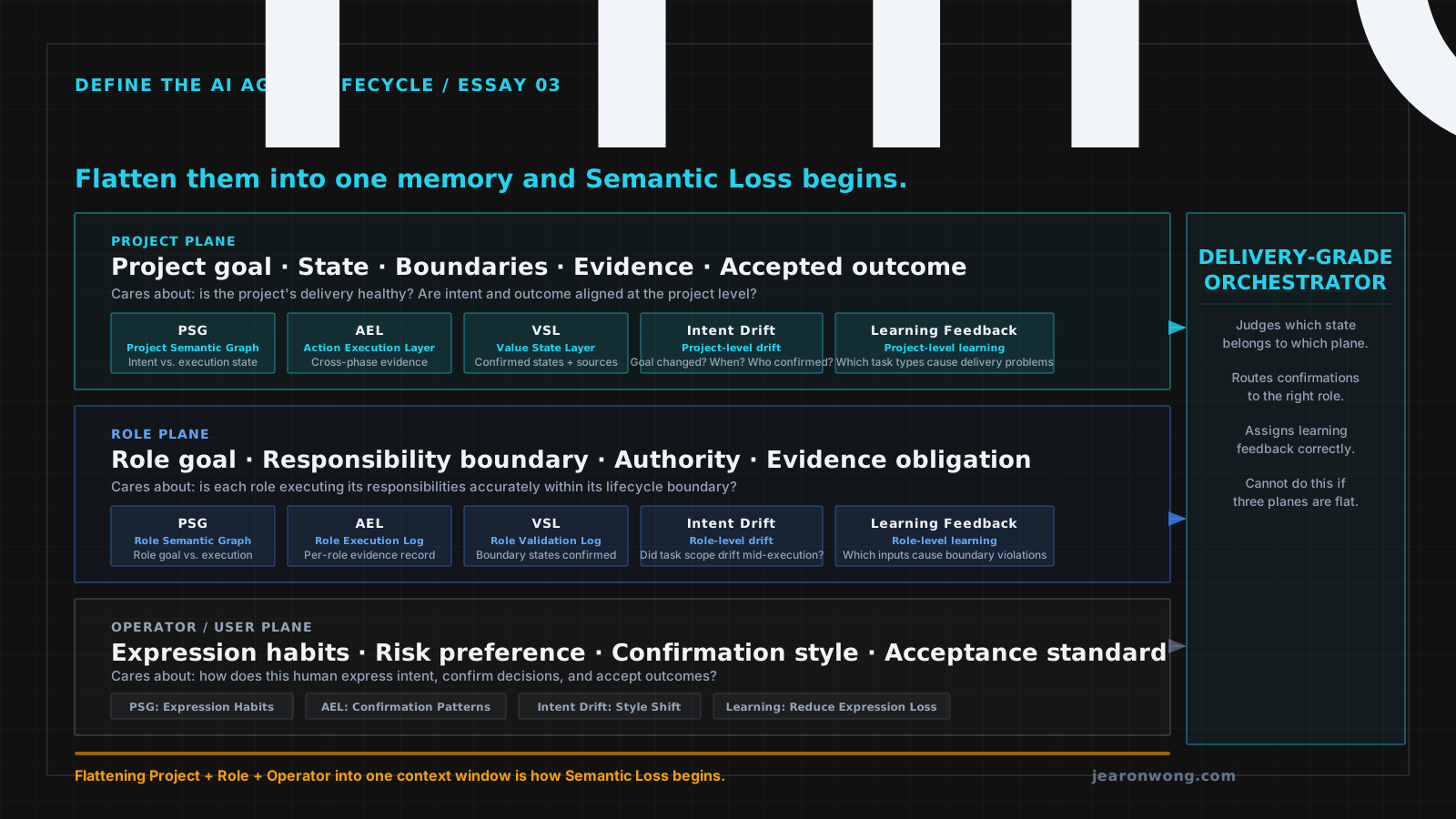
This three-plane distinction was forced out by real system requirements when designing SoloCrew’s multi-project Cell structure. One person running multiple Cells simultaneously means the project state of different Cells, the responsibility state of different Agent Roles, and the expression and confirmation habits of the operator constitute three completely different information flows in the system. Compressing them into one memory creates Semantic Loss.
A delivery-grade Orchestrator must maintain three semantic planes — not one memory:
Project Plane
The project plane is concerned with project delivery itself: the current definition and history of the project goal; project-level Intent Drift (what drift occurred and when, who confirmed the drift was valid); the current state of project boundaries (which scopes are confirmed, excluded, unresolved); project-level Evidence (evidence of completion across phases, constituting the source of accepted outcome); project-level Learning Feedback (which task types more easily cause problems in this project, which boundary checks were bypassed).
The Project Plane’s PSG (Project Semantic Graph) records the semantic relationship between project intent and execution state. The Project Plane’s AEL (Action Execution Layer) is concerned with how cross-phase execution is authorized, intercepted, and recorded, and what events and evidence must be left before and after execution. The Project Plane’s VSL (Value State Layer) records the source, version, and inheritance relationship of each confirmed state, and which states have become invalid due to confirmation, rollback, or compensation.
Role Plane
The role plane is concerned with the responsibility execution state of each Agent Role: role goal (what this Role needs to accomplish in its current activated state); role responsibility boundary (what is within and outside this Role’s scope); role authority (which tools are permitted, which resources accessible); role Evidence Obligation (what evidence this Role must produce before handoff); role execution experience (what boundary problems and decision patterns in past activation cycles); role-level Intent Drift (whether the task definition drifted during execution); role-level Learning Feedback (what task inputs more easily lead this Role to boundary violations).
The role plane’s learning goal differs from the project plane. The project plane cares about “whether project delivery is healthy”; the role plane cares about “whether this Role’s responsibility execution is accurate.” These two answers can be completely different: a Role executing responsibilities with precision, in a project heading in the wrong direction, will precisely deliver the wrong work.
Operator / User Plane
The operator plane is concerned with the individual human’s characteristics: expression habits (how this operator tends to describe requirements); risk preference (when they tend to push forward, when to halt); confirmation style (what their confirmation behavior typically means — is their “OK” a light acknowledgment or a strong confirmation); acceptance standard (at what quality level they typically accept delivery); judgment style (whether they tend toward caution or risk-taking under uncertainty).
The operator plane’s learning goal is to understand how a specific human interacts with the system, so the system can more accurately translate human intent into Lifecycle Responsibility from the Human Role perspective. This is not imposing operator preferences onto the system — it is reducing expression loss at the human-machine interface.
A concrete example: an operator, across several low-risk projects, habitually responds to progress updates with “OK, let’s go with this for now.” In those contexts, this is a light acknowledgment — meaning continue exploring, not final acceptance.
But if the system writes this operator expression pattern into the project plane, treating “OK, let’s go with this for now” as a project-layer acceptance signal, then in a high-risk project the same phrase could be misjudged as a strong confirmation. The Evidence / Acceptance threshold would be systematically lowered, and boundaries that should trigger review would be bypassed.
This is not the Agent producing a bug.
This is writing operator-plane expression habits incorrectly into project-plane semantic state. Two problems that appear related in form — both handling “this person’s confirmation” — but serving completely different truths: one is “how to understand this person’s way of speaking,” the other is “whether this project’s delivery has been truly accepted.”
Compressing them into one memory produces answers that are formally complete but semantically misaligned.
These foundational abstractions were first distilled when designing MPLP. The core question at the time was: how to enable Agents to truly complete project delivery in complex scenarios? Working through that question, I realized that execution evidence, state inheritance, relationship graphs, target drift, and learning feedback cannot be flattened into the same layer — leading to the following foundational design objects.
PSG (Project Semantic Graph) is not ordinary memory. It represents which objects, roles, tasks, evidence, and confirmation boundaries are related to each other in the project. Why a project arrived at this point, which result depends on which decision, which Agent Role bore which span of responsibility — these relationships cannot be preserved by context alone.
AEL (Action Execution Layer) represents the execution actions themselves. Its concern: who is permitted to execute what, whether execution crossed a boundary, what events and evidence need to be left before and after execution.
VSL (Value State Layer) represents how state is saved, versioned, and inherited. Its concern: where the current project state came from, which states can be inherited by subsequent tasks, which states have become invalid due to confirmation, rollback, or compensation.
Intent Drift handles whether the goal has drifted. A project, after many rounds of execution, may appear to continue — but the goal it is actually pursuing has deviated from the original human intent.
Learning Feedback handles how the system learns from past execution. The most dangerous point: project-layer learning, role-layer learning, and operator-layer learning cannot be mixed together. What the project learns is how to complete delivery; what the role learns is how to fulfill responsibility; what the operator layer learns is how a specific human expresses, confirms, and accepts risk.
So PSG / AEL / VSL / Intent Drift / Learning Feedback are not created to generate complex terminology. They correspond to several categories of problems in the AI Agent Lifecycle that cannot be compressed into one memory: relationship, execution, state, drift, and learning.
But this is still only the protocol layer’s definition.
MPLP as a protocol does not prescribe how these abstractions must be implemented. It defines: if a system is to govern the AI Agent Lifecycle, it must be able to express project relationships, execution boundaries, state inheritance, intent drift, and learning feedback.
How to implement is the Runtime’s design space.
A Runtime can implement PSG as a graph database, or as event indexing with relationship projection. AEL can be a strict execution interception layer, or a runtime policy layer built around tool calls, Agent handoff, and permission checks. VSL can live in a database, versioned state storage, event sourcing system, or some App-specific state projection.
Similarly, the App layer can re-project these capabilities according to its own domain. Software development teams, e-commerce operations, customer service systems, content production, solo entrepreneur Cells — none need to present PSG / AEL / VSL in the same interface, data model, or workflow.
This is the foundational architectural thinking of a protocol.
The protocol defines what must be preserved.
The runtime decides how to preserve it.
The application maps both into a real domain.
If MPLP directly prescribed specific implementations, it would become a framework.
If MPLP stayed at abstract slogans, it could not constrain delivery.
It must stand in the middle: defining lifecycle semantics and responsibility boundaries, while leaving implementation mechanisms to different Runtimes and different Apps.
Three planes each have different learning goals, serving different questions, and cannot be mixed into one memory.
Project has one semantic state.
Each role has another.
The human operator has another.
Flattening these into one context window is how Semantic Loss begins.
If the Orchestrator cannot distinguish these three layers, it cannot correctly route confirmation requests (who should confirm this, in what role), cannot correctly attribute evidence (does this record belong to the project layer or the role layer), cannot correctly update learning feedback (was this boundary violation a Role problem or a project goal problem).
An Orchestrator that flattens three layers of state into one context can coordinate execution — but it cannot maintain bidirectional mapping. Because every node of bidirectional mapping — Human Role, Lifecycle Responsibility, Agent Role, Evidence, Review — needs to know which layer it belongs to, what question it serves, and what layer’s state drives it.
This is the true source of Semantic Loss — not a context length problem, but a misalignment of semantic planes.
What the market has built
Today’s mainstream Agent frameworks and platforms have built large amounts of genuinely valuable capability.
They are not weak systems. They solve real engineering problems.
LangGraph / LangChain enhanced stateful graph execution: stateful graph, nodes / edges / state, checkpoint, durable execution, handoff, thread persistence, supervisor / swarm patterns. It makes Agent workflows persistent, recoverable, traceable, and schedulable.
OpenAI Agents SDK defined basic primitives for Agent runtimes: tools, handoffs, guardrails, tracing, Responses API stateful interactions, input/output/tool guardrails. It standardizes Agent-to-tool connection and Agent handoff.
CrewAI built multi-Agent teams and process automation: crews, flows, agents, tasks, processes, event-driven workflows, state, callbacks, guardrails, enterprise deployment / triggers / RBAC. It makes business process automation organization closer to human team structure.
AutoGen (Microsoft) focuses on conversation-centered multi-Agent coordination: multi-agent teams, group chat, round robin, selector, swarm, Magentic-One, handoff, termination conditions, save_state / reset / resume. It provides substantive framework for multi-Agent systems in conversational collaboration scenarios.
Microsoft Semantic Kernel Agent Framework provides multiple orchestration patterns: sequential orchestration, concurrent orchestration, group chat orchestration, handoff orchestration, GroupChatManager, termination / user input / result filtering. It gives enterprise Agent coordination more structure.
Google ADK designed a complete Agent hierarchy and workflow composition: BaseAgent, LlmAgent, SequentialAgent, ParallelAgent, LoopAgent, parent/sub-agent hierarchy, session.state, agent transfer, AgentTool, callbacks, tools. It makes multi-layer Agent structure composition more flexible.
AWS Bedrock Agents built supervisor-collaborator routing in enterprise cloud environments: supervisor agent, collaborator agents, supervisor mode, routing mode, action groups, knowledge bases, guardrails, IAM / deployment / encryption / session TTL. It embeds Agent orchestration into enterprise cloud infrastructure.
Salesforce Agentforce designed a CRM-native topic/action execution layer: topics, instructions, actions, Atlas Reasoning Engine, Flow, Apex, CRM / Data Cloud integration, Trust Layer. It has unique advantages in deep integration with CRM data and business scenarios.
IBM watsonx Orchestrate provides enterprise agents, skills, tools, collaborators, knowledge sources, automations, Agent Builder, prebuilt agents/tools, MCP servers, CLI / Developer Edition. Its focus is enterprise task automation and skills/tools catalog.
LlamaIndex built retrieval-intensive multi-Agent workflows: AgentWorkflow, root agent, handoff tool, orchestrator agent, custom planner, workflow context, global state, event stream, tool call events, serializable context. It has deep depth in RAG and Agent integration scenarios.
Pydantic AI built a typed, observable Agent execution stack: typed agents, structured output, tools/toolsets, dependencies, delegation, programmatic handoff, Pydantic Graphs, Deep Agents, Logfire observability, cost/tool shields, guardrails, subagent task toolset. It brings type safety and observability to Agent runtimes.
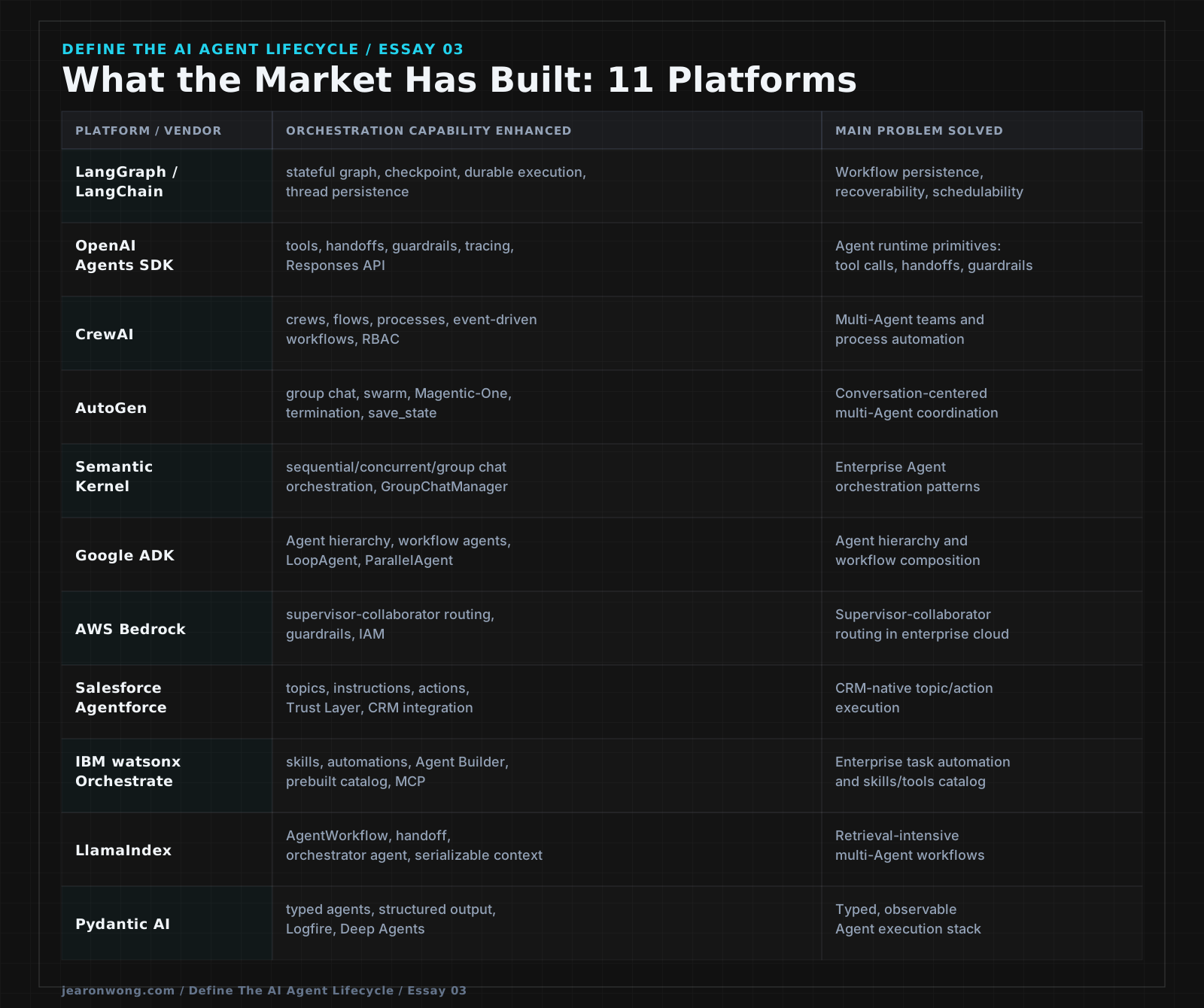
These systems are valuable. They are not weak systems.
What these frameworks jointly lack is not another handoff primitive or another graph pattern. What they have not systemically defined is accepted outcome semantics: when can an execution result be called delivery, who authorized it, what evidence supports it, who bears responsibility, and how that responsibility traces back.
In other words, they can answer very well how work continues — but they have not yet systemically answered when work can be accepted.
But they primarily solve execution coordination.
They have not systemically defined the complete responsibilities of a delivery-grade orchestrator in the AI Agent Lifecycle: semantic consensus generation, dynamic Role Graph governance, lifecycle-bound verifiable objective distribution, Human Role Confirmation Boundary, multi-layer semantic state convergence, maintaining bidirectional responsibility mapping — these responsibilities are, in today’s frameworks, either undefined or left for users to implement themselves.
All of these solve execution coordination. None of them, by that fact alone, define when execution becomes delivery.
This is not a criticism of their quality. It is naming the fact that between execution coordination and delivery-grade orchestration, there is a layer of structural gap the industry has not yet systemically defined.
Protocol layer, Runtime layer, Application layer
The solution to this layer gap is not in any single Orchestrator framework.
It lives across three levels.
The protocol layer defines what must be preserved.
The protocol layer does not implement any Runtime capability, but it defines: in the AI Agent Lifecycle, what must be preserved for an Orchestrator to count as delivery — Scope, Authority, Role responsibility, Confirmation Boundary, Evidence Chain, Review state, Accepted Outcome, Traceability, Lifecycle state transition, Drift event, Learning sample. The protocol layer answers: what must remain governable?
The runtime layer decides how to preserve it.
The runtime layer implements specific Orchestrator capabilities: the three-perspective adjudication mechanism of the Orchestrator consensus layer; activation, monitoring, and deactivation of the dynamic Role Graph; handoff policy and task distribution protocol; multi-layer state persistence of PSG / AEL / VSL; Intent Drift detection and Learning Feedback attribution; Human Role Confirmation routing; Evidence collection and rollback/compensation mechanisms; deterministic gates (setting deterministic judgment gates around LLM decisions); policy-based adjudication (adjudicating through policy rules, role confirmations, escalation rules). The runtime layer answers: how is governance executed technically?
The application layer maps both into real business domains.
The application layer maps what the protocol layer defines as “what must be preserved” and what the runtime layer implements as “how to preserve it” into specific user scenarios: software development team delivery processes, content operations release review, enterprise procurement approval chains, customer service ticket handling and escalation, solo entrepreneur single-person multi-Agent operations, cross-project knowledge inheritance and Role reuse. The application layer’s question is: in this specific business domain, what does delivery mean?
The protocol defines what the orchestrator must preserve.
The runtime decides how to preserve it.
The application maps both into a real domain.
MPLP is the protocol path I have built for this problem.
MPLP does not replace the Orchestrator. It defines what the Orchestrator must preserve in order to count as delivery. This argument is broader than MPLP: others may choose to use MPLP as the protocol layer, or design different Runtime and App layer mappings to achieve these capabilities. MPLP is a protocol path, not the only solution.
Three essays, one structure
The first essay traced how the AI Agent Lifecycle grew from real engineering failures. Projects lost control — not because Agents were insufficiently capable, but because project state had no lifecycle structure to carry it. Intent drifted. Context corrupted. Confirms had no downstream consequences. Delivery had no accepted state. The first essay’s conclusion:
Execution is not delivery. AI Agent work needs a lifecycle.
The second essay arrived at the same structure from another direction. When designing HITL for real multi-Agent products, I found that HITL without a responsibility structure is theater. Tagging Agents with human role labels without decomposing the responsibilities behind those labels produces systems that look like teams but behave like isolated executors. The second essay’s conclusion:
More agents are not MAS. Multi-agent work needs lifecycle responsibility separation.
This essay arrives at the third layer:
When the Orchestrator holds goal decomposition authority and task distribution authority, it can no longer be just an execution router. It must maintain bidirectional mapping between human intent and agent execution, manage the dynamic Role Graph, transform tasks into verifiable objectives, transform HITL into Human Role Confirmation Boundary, and maintain independent state, Intent Drift detection, and Learning Feedback across Project / Role / Operator semantic planes.
Orchestration is not delivery. AI Agent Lifecycle Orchestration needs lifecycle responsibility consensus and bidirectional responsibility mapping.
Placing the three essays together, the structure becomes complete:
Agent execution needs lifecycle.
Multi-agent execution needs lifecycle responsibility separation.
Lifecycle orchestration needs bidirectional responsibility mapping and semantic consensus.
This is not a critique of today’s tools. It is naming the next layer of problems.
Execution makes agents useful.
Lifecycle makes agent work trustworthy.
A delivery-grade orchestrator makes project outcomes determinately accountable.
This is the third essay in the Define The AI Agent Lifecycle series.
Essay 1: AI Agent Lifecycle: It Was Not Designed. It Grew.
Essay 2: The Industry Misdefined Multi-Agent AI
AI Agent Lifecycle definition — Delivery Standard — AI Agent Governance — MPLP Protocol Path
Continue from this record
Publication sequence
Recommended proof path
If you only follow one next step after the thesis, continue from MPLP to Cognitive OS.