A task can be executed. Real work must be delivered.
By Jearon Wong
The AI agent industry has a measurement problem.
We measure token usage, tool call success rates, workflow completion, trace coverage, evaluation scores, and latency. We celebrate agents that can search the web, write code, send emails, browse interfaces, call APIs, and coordinate across tools.
These are real achievements.
But they are measurements of execution, not delivery.
The question the industry has not yet fully confronted is simpler and harder:
Can an AI agent system carry a piece of real work from human intent to accepted outcome — across time, context, decisions, changes, tools, and accountability?
I call this shift Agentic Project Delivery — the ability of AI agent systems to carry work from human intent to accepted outcome across time, context, decisions, changes, tools, and accountability.
The first era of Agentic AI established that agents can execute.
The next era will be defined by whether they can deliver.
The Industry Is Optimizing the Wrong Unit
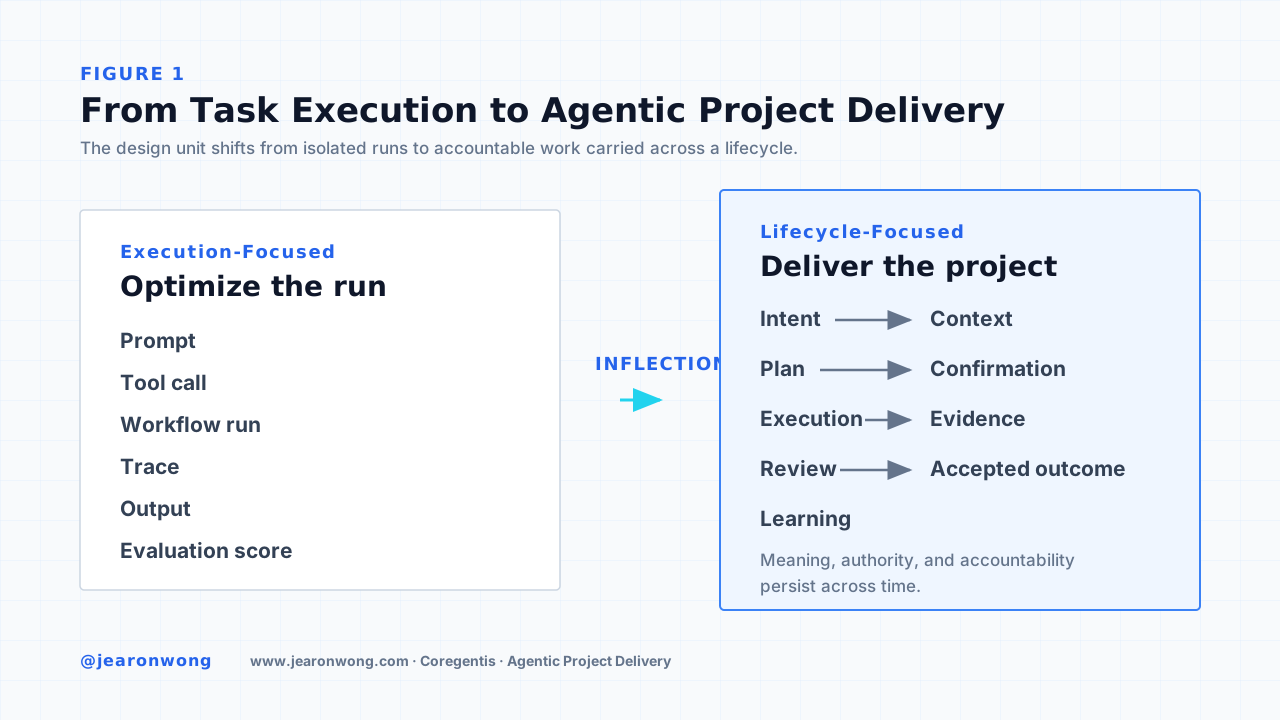
Most discussions of AI agents focus on execution units:
the prompt,
the tool call,
the workflow run,
the trace,
the evaluation score,
the token budget.
These units are measurable, improvable, and demonstrable.
They are also not the right unit for understanding whether Agentic AI is actually useful.
A lawyer does not bill by the sentence.
A software team does not ship by the function.
A business does not succeed by the action.
Real work is organized, measured, and judged at the level of projects — coherent units of effort that begin with intent and end with an accepted outcome.
The deepest question about Agentic AI is not whether an agent can execute more steps.
It is whether an agent system can operate reliably at the level where real work actually lives:
the project lifecycle.
Today’s dominant agent frameworks are built to answer a different question:
Can we make agents runnable, composable, observable, and evaluable?
These are essential questions. They establish the technical foundations of agent systems.
But they leave a more fundamental question unanswered:
Can the system sustain the meaning, accountability, and continuity of real work from beginning to end?
The real unit of Agentic AI is not the prompt, the tool call, the workflow run, or the trace.
It is the project lifecycle.
A Task Can Be Executed. A Project Must Be Carried.
The distinction between a task and a project is not cosmetic.
It is architectural.
A task has a local horizon. It begins with an instruction and ends with an output. Success is measured by whether the output was produced correctly. The execution context is usually bounded. When the task is done, the agent’s responsibility appears complete.
A project has a different structure entirely.
It begins with human intent — a goal, a desired outcome, and a set of constraints that reflect real-world priorities.
It unfolds across time, through planning, decisions, uncertainty, change, and review.
It may involve multiple people, agents, tools, systems, and handoffs.
It requires context and accountability to survive across all of those transitions.
And it ends not when the last action is executed, but when the outcome is accepted as satisfying the original intent.
The gap between these two structures is not merely a gap in model capability.
It is a gap in what agent systems are designed to carry.
A task-oriented system asks:
Did the agent complete the instruction?
A project-oriented system asks:
Did the work reach an accepted outcome that satisfies the original intent, under the constraints that were established, through a process that remains understandable and accountable?
These are genuinely different questions.
And they produce genuinely different architectures.
Two Starting Points, Two Different Architectures
The agent frameworks that dominate today were largely built from an engineering-first starting point.
This was the right starting point for the first era of Agentic AI. Without it, agents would not have become technically viable.
The engineering-first path looks like this:
Model integration
→ Tool calling
→ Workflow orchestration
→ State persistence
→ Human-in-the-loop support
→ Tracing and observability
→ Evaluation and monitoring
→ Deployment and scaling
At each step, the question is:
How do we make the execution layer more capable, more reliable, and more observable?
This path produces systems that are buildable, runnable, debuggable, and deployable.
It is the necessary foundation.
But it carries a structural tendency: the most visible unit of design often remains the execution run. The system is organized around what happens inside a run — the tool calls, the state transitions, the outputs generated, the traces emitted, the evaluations performed.
What happens between runs, across runs, and above runs receives less structural attention.
A lifecycle-first starting point asks a different question from the beginning:
Intent
→ Context
→ Plan
→ Confirmation
→ Execution
→ Evidence
→ Review
→ Acceptance / Iteration / Closure
→ Learning
Here, the unit of design is the project lifecycle.
The question at each step is not only:
Did execution succeed?
The deeper question is:
Is the work still aligned with the original intent, within its constraints, under appropriate authorization, and moving toward an acceptable outcome?
This produces a different architecture — one organized around the continuity of meaning across the work, not only the mechanics of execution inside a run.
Engineering-first systems make agents executable. Lifecycle-first systems make agent work deliverable. Production-grade Agentic AI requires both.
The first era gave us execution.
The inflection point is the transition to delivery.
Figure 1 — From Task Execution to Agentic Project Delivery
Why Execution Alone Does Not Guarantee Delivery
Consider what execution success actually guarantees.
An agent completes a hundred tool calls without error.
The workflow reaches its terminal state.
The trace is complete.
The evaluation score is high.
By every execution metric, the run succeeded.
And yet the project may still fail.
This failure mode is not hypothetical. It appears consistently as agent systems move from demos into real work.
Consider four patterns that repeat across production deployments:
An agent executes precisely what it was instructed to do in the most recent session, but that instruction has drifted from the project’s original intent across multiple sessions of accumulated context.
Nobody notices until the final output is reviewed.
A workflow completes on schedule, but the output cannot be accepted by the downstream team because the constraints they operate under were never represented in the execution context.
The agent had no way to know.
A trace shows every action the agent took, but when the outcome is questioned three weeks later, the team cannot explain why a particular decision boundary was crossed.
The authorization existed somewhere in conversation history.
The rationale did not survive as a structured artifact.
Multiple agents collaborate on a complex deliverable, each performing its assigned function correctly. The handoffs between agents lose critical context at each transition. The final output is internally coherent but externally wrong — right by the agents’ understanding of the task, wrong by the project’s actual requirements.
In each case, execution succeeded.
Delivery failed.
The gap between them is not only a model capability problem.
It is a structural problem in how the system represents and carries work.
Execution success is not the same as project success.
The Hidden Cost: Intent Attrition
The agent industry currently measures efficiency in terms of token usage, latency, tool call counts, and workflow completion.
These are real costs worth optimizing.
They are not the deepest efficiency problem.
The deeper problem is the loss of work meaning across time and execution.
I call one of its most important forms Intent Attrition.
Intent Attrition, used here in a project-lifecycle sense, is the gradual weakening, distortion, or loss of original intent as work moves across time, agents, tools, conversations, execution steps, and changing context.
In this essay, Intent Attrition does not mean only “the user’s initial instruction was forgotten.” It refers to the gradual loss or distortion of the original goal, constraints, decision context, accountability, and acceptance criteria as work is carried through a system.
Intent Attrition manifests in predictable ways.
A project begins with a clear goal and a set of explicit constraints. After three sessions and twelve tool calls, the constraints have been partially overridden by accumulated intermediate decisions. The agent is still executing correctly — but it is executing against a subtly different understanding of the project than the human established at the start.
A human makes a consequential decision at a key moment in a workflow. The decision is recorded as a state transition. Two weeks later, when the decision’s consequences appear in the output, nobody can reconstruct what options were presented, what reasoning was offered, or what the decision-maker believed they were authorizing.
An agent workflow runs for four days across multiple sessions. The original intent remains nominally present in a prompt or task description. But the effective context the agent is reasoning against has shifted considerably. Accumulated outputs, intermediate decisions, and tool responses have changed what the agent treats as salient.
The output on day four is coherent.
But it is directionally wrong.
Intent Attrition is why agents can generate impressive outputs and still fail projects. It is why organizations that successfully deploy agent pilots often struggle to trust agents with consequential, long-running work.
It is also why the production adoption curve for Agentic AI tends to flatten at the point where work becomes complex enough to matter.
The biggest cost in agent systems is not token usage. It is Intent Attrition.
Token cost matters.
Latency matters.
Evaluation quality matters.
But many of these costs are symptoms of a deeper structural issue: the system has not preserved enough project meaning to avoid repeated reconstruction, drift, ambiguity, and rework.
Intent Attrition is a lifecycle problem, not merely an execution problem.
It will not be solved by a better model, a faster tool-calling loop, or a more comprehensive trace alone.
It requires agent systems that treat the preservation of intent as a first-class architectural concern across the full project lifecycle.
Lifecycle Structure Reduces Rework, Drift, and Repeated Context Reconstruction
The efficiency argument for lifecycle-first design is direct.
In a task-oriented agent system, every new session risks context reconstruction. The human re-explains the goal. The agent re-reads accumulated history. Relevant constraints are reasserted. Previous decisions are re-established. The system attempts to infer what still matters from a mixture of prompts, logs, retrieved context, tool outputs, and memory.
This reconstruction is invisible overhead.
It does not always appear clearly in token counts or latency measurements, but it consumes significant human attention and introduces consistent opportunities for Intent Attrition.
In a lifecycle-oriented agent system, the project’s intent, context, constraints, decisions, and authorization history are treated as first-class structured artifacts. They persist across sessions not merely as unstructured conversation history, but as maintained project state that the system can reference, update, and review.
Context reconstruction is not eliminated.
But it is replaced by a more disciplined operation: retrieving and maintaining project meaning instead of repeatedly rediscovering it.
The efficiency gains compound across the project.
Fewer sessions are lost to re-establishing context.
Fewer outputs are rejected because constraints were not represented.
Fewer handoffs lose critical information.
Fewer decisions become impossible to reconstruct later.
Fewer reviews require starting from scratch because the evidence trail is incomplete.
Fewer projects are abandoned because the accumulated state becomes too complex to inherit.
I call this Lifecycle Efficiency.
Lifecycle Efficiency, as defined here, is the efficiency gained by preserving work meaning, context, decisions, constraints, and accountability across the project lifecycle — rather than merely accelerating execution inside a run.
Lifecycle Efficiency reduces rework, drift, repeated context reconstruction, failed handoffs, unreviewable decisions, and project abandonment.
This is why engineering-first optimization has diminishing returns at a predictable point.
The limits of execution-layer efficiency are reached earlier than the limits of lifecycle-layer efficiency, because Intent Attrition compounds in ways that no amount of execution optimization can fully absorb.
Good Output Is Not the Same as Accepted Work
Evaluation frameworks for agent systems ask a valuable question:
Was the output good?
Was it accurate?
Relevant?
Well-reasoned?
Did it pass the rubric?
Did it regress from the previous baseline?
These questions matter.
They are the right questions for measuring execution quality.
But production deployment introduces a different question that evaluation frameworks were not primarily designed to answer:
Was this work acceptable?
The distinction is between output quality and work acceptance.
Work Acceptance, as used here, means that a project outcome does not merely score well as an output, but can be accepted under the original intent, constraints, authorization, and responsibility boundaries of the project.
Acceptability is not the same as quality.
An output can score well on every quality dimension and still fail to be acceptable — because it exceeded the authorized scope, violated a constraint not represented in the evaluation rubric, was produced under conditions the project’s stakeholders did not sanction, or cannot be traced to the intent that initiated the work.
The distinction becomes concrete in consequential deployments.
A legal team deploys an agent to draft contract clauses. The output is high quality by many evaluative measures. But the draft includes provisions that fall outside the scope the legal team authorized the agent to cover. The output cannot be accepted, not because it is badly written, but because it exceeds the authorized boundary.
A content team runs an agent across a three-month editorial calendar. Evaluation scores remain high throughout. But by month three, the output has drifted from the editorial voice and strategic direction established at the start. Individual outputs are good. The body of work is not acceptable as a coherent project deliverable.
An enterprise AI system executes a complex workflow and produces a decision recommendation. The recommendation is well-reasoned and technically sound. But the team cannot accept it because they cannot reconstruct the authorization chain that permitted the agent to access the data it reasoned from.
In each case, evaluation answered the quality question.
It did not answer the acceptance question.
Acceptability is a lifecycle property, not only an output property. It depends on whether the work remained within its intended scope, whether the process that produced it was legitimate, whether relevant decisions were preserved, and whether the outcome can be traced to the intent that initiated it.
An agent can produce a good output and still fail the project.
Lifecycle Thinking Changes Multi-Agent Design
The move to multi-agent systems amplifies every lifecycle problem.
The industry’s default approach to multi-agent design often maps agents to human-like roles:
Planner.
Researcher.
Coder.
Reviewer.
Manager.
This is intuitive and often useful for the execution layer. Each agent has a defined function. Workflows coordinate their outputs.
But as multi-agent systems become more complex and organizationally consequential, a different design question becomes pressing:
Not only what role does each agent play, but what responsibility does each agent carry across the project lifecycle?
Role-based design asks:
What does this agent do?
Lifecycle-based design asks:
Who is responsible for intent interpretation at this stage?
Who maintains context across the handoff?
Who has authority to modify the plan?
Who is responsible for confirming consequential actions?
Who maintains the evidence trail?
Who owns review and acceptance?
These are different questions.
And they produce different architectures.
When work passes between agents in a role-based system, the handoff often transfers task instructions. Context, constraints, decision history, and authorization boundaries may or may not survive the transfer, depending on implementation.
Each agent begins its function with whatever context it receives.
When work passes between agents in a lifecycle-based system, the handoff transfers a structured work state — the intent, the plan, the confirmation history, the accumulated evidence, the current constraints, and the project’s current delivery state.
Each agent operates within a shared understanding of where the project is, how it got there, and what boundaries apply.
The difference becomes critical when something goes wrong — when a decision needs to be reviewed, an output needs to be questioned, or a project needs to be recovered.
In a lifecycle-based system, the information needed for review, audit, and recovery is structurally present.
In a purely role-based system, it may exist only in execution logs, if it exists at all.
This is the shift toward Responsibility-Preserving Multi-Agent Design.
Responsibility-Preserving Multi-Agent Design is the idea that production multi-agent systems should preserve responsibility as work moves across agents, tools, decisions, and handoffs — not merely distribute tasks across human-like personas.
Production multi-agent systems should not only distribute tasks across personas. They must preserve responsibility across the lifecycle.
What Production-Grade Agentic AI Requires
The engineering foundations of Agentic AI are substantially in place.
The tool-calling loop is reliable enough to build on. Orchestration frameworks are maturing. Observability is increasingly sophisticated. Human-in-the-loop patterns are better understood. Evaluation workflows are improving.
The next layer is lifecycle structure.
Production-grade Agentic AI requires capabilities that go beyond execution.
Project-level intent persistence. The original intent, constraints, and scope of a project need to survive across sessions, agents, and tools as structured project artifacts — not only as unstructured history that must be reconstructed from context.
Structured planning before consequential action. Before agents act on complex, multi-step work, the plan — its steps, dependencies, role assignments, and expected outcomes — should exist as an explicit, reviewable artifact. Not as a hidden reasoning trace, but as something humans and systems can inspect and revise.
Authorization at decision boundaries. Consequential actions should involve explicit human authorization that is recorded with enough context to be understood later: what was authorized, by whom, under which conditions, and for what scope.
Evidence that survives execution. The chain from intent to outcome should be reconstructable after the fact — not only by mining logs, but by following structured artifacts maintained throughout the project lifecycle.
Change handling across the lifecycle. When intent changes, constraints are updated, or scope shifts, the system needs a way to propagate those changes across the project state instead of relying on the agent to infer implications from conversation context.
Review and acceptance as lifecycle stages. The endpoint of agent work should not be only “the workflow completed.” It should be “the outcome was reviewed and accepted against the original intent.”
This requires acceptance to be a structured stage in the lifecycle, not an informal human judgment after the fact.
Agentic AI becomes useful when it can act. It becomes production-grade when its work remains understandable, reviewable, and accountable across time and change.
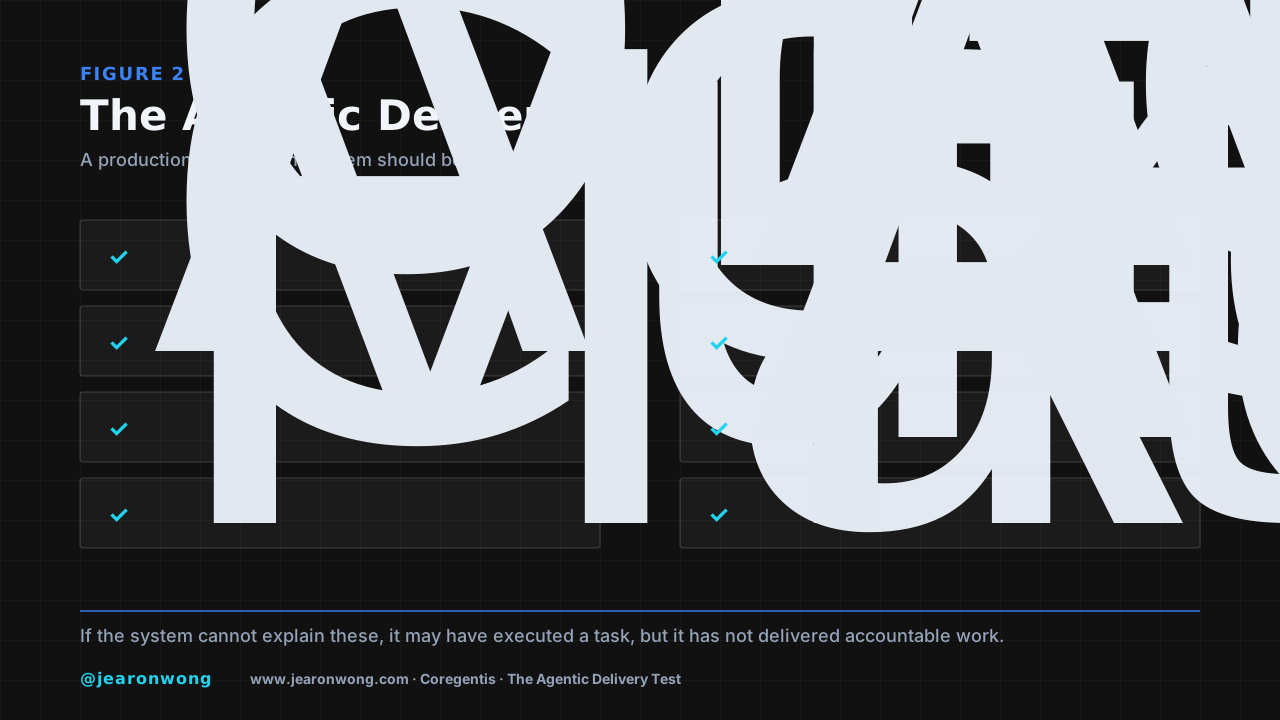
Figure 2 — The Agentic Delivery Test
The Conceptual Shift
The argument of this essay can be summarized through five conceptual shifts:
- From task execution to Agentic Project Delivery.
- From execution speed to Lifecycle Efficiency.
- From context drift to Intent Attrition.
- From output quality to Work Acceptance.
- From role-based agents to Responsibility-Preserving Multi-Agent Design.
Together, these concepts describe the same underlying transition:
Agentic AI is moving from systems that can execute actions to systems that must deliver accountable work across time.
This is not a rejection of execution-focused engineering.
Execution is necessary.
Tool calling is necessary.
Workflow orchestration is necessary.
Tracing is necessary.
Evaluation is necessary.
But they are not sufficient by themselves.
The next frontier is not simply better execution.
It is reliable project delivery.
Where the Multi-Agent Lifecycle Protocol (MPLP) Fits
If the argument of this essay is right, then production-grade Agentic AI needs a layer whose primary concern is not execution mechanics, but the continuity of work.
This is where the Multi-Agent Lifecycle Protocol (MPLP) fits.
MPLP was designed from this lifecycle-first view.
Not as a tool framework.
Not as an orchestration runtime.
But as a protocol that formalizes the lifecycle of work as a set of structured objects and relationships: how intent is represented, how plans are formed, how confirmation is recorded, how execution is traced, how roles carry responsibility, and how work closes.
MPLP starts from the question of what must be true for agent work to be deliverable — not merely executable.
It attempts to define the structural layer that sits above tool access and agent coordination, and below application logic: the layer where the meaning, authority, and accountability of work are maintained across the project lifecycle.
This is one proposed answer to the lifecycle layer problem.
The answer may take other forms, and the field will likely develop multiple approaches.
But the layer itself is necessary.
Without it, Agentic AI systems will continue to face the same ceiling:
impressive in execution,
unreliable in delivery.
MPLP is an attempt to define the lifecycle layer that makes autonomous agent work reliable across time, tools, agents, and organizational change.
The specification is open source at:
github.com/Coregentis/MPLP-Protocol
From Execution to Delivery
The first era of Agentic AI answered an important question:
Can agents be built that reliably execute complex, multi-step tasks using external tools, persistent state, and human oversight?
The answer is increasingly yes.
That answer required years of engineering investment, framework development, and production learning. It is a genuine achievement.
The inflection point now is whether the field can answer the harder question:
Can agent systems carry real work reliably from human intent to accepted outcome?
This question cannot be answered by optimizing the execution layer alone.
It requires a different layer — one organized around the project lifecycle, the continuity of intent, the structured representation of decisions and accountability, and the formal distinction between output quality and Work Acceptance.
The future of Agentic AI will not be decided only by who builds the fastest tool-calling loop or the most comprehensive evaluation framework.
It will be decided by who can help agents carry work reliably from intent to accepted outcome.
Execution matters.
Execution is the foundation.
But delivery is the promise.
And delivery happens across a lifecycle.
Lifecycle is what turns autonomous execution into reliable delivery.
Conceptual Framework Proposed in This Essay
This essay proposes a conceptual framework for understanding the next stage of Agentic AI: the shift from autonomous task execution to reliable project delivery.
Some of the phrases below may appear in adjacent contexts across AI, software delivery, or governance. I use them here with specific definitions in the context of production agent systems and project lifecycle architecture.
- Agentic Project Delivery
- Used here as a lifecycle architecture concept: the ability of an AI agent system to carry work from human intent to accepted outcome across time, context, decisions, changes, tools, and accountability.
- Intent Attrition
- Used here in a project-lifecycle sense: the gradual weakening, distortion, or loss of original intent as work moves across time, agents, tools, conversations, execution steps, and changing context.
- Lifecycle Efficiency
- Defined here as the efficiency gained by preserving work meaning, context, decisions, constraints, and accountability across the project lifecycle — rather than merely accelerating execution inside a run.
- Work Acceptance
- The distinction between output quality and project-level acceptance: an output can score well and still fail to be acceptable under the project’s original intent, constraints, authorization, and responsibility boundaries.
- Responsibility-Preserving Multi-Agent Design
- The idea that production multi-agent systems should preserve responsibility as work moves across agents, tools, decisions, and handoffs — not merely distribute tasks across human-like personas.
- Execution-First vs Lifecycle-First Architecture
- The framing used in this essay to distinguish systems designed primarily from execution mechanics from systems designed around the full lifecycle of work.
Together, these concepts describe the same underlying transition:
Agentic AI is moving from systems that can execute actions to systems that must deliver accountable work across time.
Jearon Wong is the founder of Coregentis and the primary author of the Multi-Agent Lifecycle Protocol (MPLP), an open specification for agent lifecycle governance. He writes about production agent systems and protocol-layer infrastructure at www.jearonwong.com.
Continue from this record
Publication sequence
Recommended proof path
If you only follow one next step after the thesis, continue from MPLP to Cognitive OS.