The market does not lack agent frameworks or governance tools. What is missing is a protocol-native, vendor-neutral lifecycle layer that carries intent, authority, evidence, handoff, and accepted outcome semantics across system boundaries.
Ask a CTO today how they govern agentic AI deployments and you will likely hear about a familiar set of tools: LangSmith for observability and evaluation, LangGraph for stateful orchestration, a compliance dashboard for audit trails, and Palantir for enterprise context. These are real capabilities from serious companies. LangSmith positions itself as a platform to observe, evaluate, and deploy reliable AI agents.[1] LangSmith LLM Gateway is described by LangChain as a runtime governance layer for policy enforcement during model calls.[2] CrewAI documents guardrails, memory, knowledge, and observability as framework-native capabilities.[3] Palantir AIP integrates agent actions, human review workflows, and granular access control with its Ontology, while Palantir describes AIP, Foundry, and Apollo together as an operating system for enterprise AI workflows.[5][6]
Those are not empty slogans. They represent genuine and useful engineering. The challenge is not that any one of them is weak.
The challenge is what happens when they need to work together: when a LangGraph orchestrator hands off to a CrewAI crew, which triggers a compliance check on a third-party platform, which writes back to a Palantir Ontology object. Each system has its own trace format, its own approval mechanism, and its own definition of what “confirmed” means. There is no shared protocol layer that defines lifecycle semantics across the boundary. When something goes wrong, reconstructing accountability requires forensic work across incompatible log schemas. When a regulator, risk officer, or internal reviewer asks whether an agent acted within its authorized scope, the answer lives in no single system.
This is the problem MPLP - Multi-Agent Lifecycle Protocol - addresses. Not by building a better framework, and not by claiming to be an adopted standard, but by defining a protocol layer for lifecycle semantic objects that agent frameworks, enterprise systems, and governance tools can implement and communicate through.
The Stitching Model and Its Structural Cracks
The dominant enterprise pattern for Agentic AI today is a three-layer stitch: an agent execution framework handles orchestration; a governance platform handles observability and audit; an enterprise object system handles business context. Each layer is purchased or built separately, then integrated.
Even when every layer is mature, the stitch produces structural cracks.
The execution framework knows what the agent did, but not under which authority boundary it did it. The governance platform records the post-hoc trace, but its evidence schema is incompatible with the execution framework's trace schema. The enterprise object system stores business context, but has no native concept of the agent lifecycle state. The seams between these layers are where accountability gaps live.
These gaps are not theoretical. They surface in post-incident reviews: which agent, under whose authority, made the decision to proceed? Was the human approval for the original intent, or for a downstream action the human never saw? At what point did the agent’s effective scope drift from what was originally authorized? In a stitched system, these questions are often answered by reconstructing a story from incompatible logs.
The deeper issue is structural. You can improve any individual layer, but stitching alone cannot achieve what a shared protocol provides. The governance layer can only record what the execution layer chooses to expose, in whatever format it chooses to expose it. Without a protocol - a shared specification for what an Intent object must contain, what a Confirmation Boundary requires, and what an Accepted Outcome records - the seams remain.
What Protocol-Native Actually Means
The thesis is exact: the native MAS OS generation defines Intent versioning, real-time Drift Detection, HITL Confirmation Boundaries, portable Evidence chains, Agent Handoff semantics, and Outcome Governance at the protocol layer. That is the same kind of architectural move TCP/IP made for networking, SWIFT made for financial messaging, and HTTP made for the web. MPLP makes that move for Agentic AI.
The phrase “same kind of move” matters. It is an architectural analogy, not an equivalence claim. TCP/IP, SWIFT, and HTTP earned their authority through adoption, implementation, institutionalization, and time. MPLP is not being described as having that status. The claim is narrower: the missing layer in Agentic AI is the protocol layer where cross-system lifecycle semantics can be represented once and carried everywhere.
In practice, vendor-neutral lifecycle primitives mean this: when a LangGraph agent hands off to a CrewAI crew, and that crew escalates to a human reviewer on a third-party compliance platform, every transition can carry the same protocol objects. The evidence does not need to be translated after the fact. The authority chain does not need to be reconstructed from logs. The Confirmation Boundary is represented at the protocol layer before the framework-specific action proceeds.
This is what separates a protocol layer from a governance tool. A governance tool records what happened. A protocol layer defines what must be represented before, during, and after action: intent, authority, confirmation, evidence, responsibility, accepted outcome, and remediation.
The Intent Drift Problem
Every multi-step agent system faces a subtle risk: by the time an agent completes its task, it may be doing something materially different from what was originally authorized. This is Intent Drift - the accumulation of contextual shifts that moves execution outside the original authorized scope without an explicit decision to change direction.
Consider a financial analyst agent tasked with researching investment opportunities in Southeast Asian equity markets. The original Intent is limited: analyze market conditions, identify candidates, produce a summary report. By step 15, after multiple tool calls and context updates from live data feeds, the agent has begun modeling leverage scenarios for specific issuers based on credit default swap spreads. It is now, effectively, acting as a trading model - a role it was never authorized to perform.
LangSmith traces may show every tool call. CrewAI observability may log every agent action. But neither system, by default, defines a cross-framework protocol object that compares the current execution scope against the original authorized Intent and triggers a re-confirmation boundary when the gap exceeds a defined threshold. The drift is visible in logs. It is not necessarily caught during execution.
MPLP addresses this with versioned Intent objects and Drift Detection as protocol-level state transition conditions. The original Intent is captured with scope, authority boundary, and context snapshot at the start of the lifecycle. As execution proceeds, a runtime implementing MPLP semantics can evaluate whether the current execution context still falls within the bounds of the active Intent. If it does not, the runtime can suspend, escalate, or request re-confirmation as a governed state transition.
For regulated industries, the distinction is practical. The EU AI Act requires risk management, logging, record-keeping, and human oversight obligations for high-risk AI systems.[8] That does not mean MPLP proves legal compliance. It means protocol-level Intent, Evidence, Confirmation Boundary, and Replay semantics are structurally aligned with the kinds of evidence such regimes ask organizations to produce.
MPLP: Agent OS Protocol Layer, Not Governance Middleware
MPLP is not a governance tool added on top of an existing agent framework. It is a protocol layer that defines lifecycle semantics of agentic work: from intent and authority through confirmation, execution, evidence, outcome acceptance, and remediation. It is designed as a vendor-neutral specification that runtimes can implement.
MPLP is also not a complete operating system. It defines protocol rules that make an Agent OS possible. A Cognitive OS runtime implements those rules and executes control logic against them. MPLP defines what must be represented. Cognitive OS makes those representations operational.
The protocol covers three dimensions at once.
Runtime
Governance
Protocol
The critical difference from framework-level governance is that these three dimensions share the same protocol layer. An Intent object that carries authority boundary information can also carry evidence linkage references. A Confirmation Boundary that triggers human review can produce an EvidenceRecord. A Drift Detection event that triggers escalation can update the Responsibility Mapping. The coherence is structural, not engineered on a per-project basis.
# Platform-native trace — recorded after execution
tool_called:  initiate_payment
output:       success
trace_id:     ls-abc123f
user_action:  approved

# Governance: platform-specific
# Authority boundary: developer-defined
# Cross-system evidence: manual integration
# Portability: platform-bound
intent_version:      v3
authority_boundary:  payment_review_L2
risk_state:          elevated
confirmation:        human_required
evidence_pointer:    KYT_signal+ctx_v3
responsibility:      compliance_officer
outcome_status:      accepted
remediation:         closed
The right-side objects are not framework records. They are portable protocol artifacts. A runtime implementing MPLP semantics can consume, validate, and act on them, regardless of which agent framework generated the underlying event.
One Protocol Layer, Two Types of Systems It Can Support
Because MPLP defines execution semantics, lifecycle control semantics, and object semantics at the protocol layer simultaneously, it can support two structurally different types of systems.
Agent Runtime Layer
The LangChain ecosystem offers serious production capabilities: observability, evaluation, deployment infrastructure, LLM Gateway policy enforcement, human-in-the-loop approvals, and stateful orchestration.[1][2]
The boundary: these capabilities are platform and ecosystem features. When architecture crosses into another framework, a third-party compliance platform, or an enterprise object system, the governance semantics do not automatically travel as portable protocol primitives.
Enterprise Object Runtime
Palantir AIP and Ontology are serious reference points for enterprise AI. Ontology turns enterprise data and actions into AI-operable objects, and AIP describes integrated security, audit, resource management, and workflow capabilities.[5][6][7]
The boundary: Palantir Ontology is enterprise-business-object-native, not agent-lifecycle-native. Agent Intent, Confirmation Boundary, Accepted Outcome, and Remediation Closure are not its primary public design primitives. Cognitive OS is designed around those lifecycle semantics as first-class objects.
An analogy that clarifies the relationship: Palantir AIP is to enterprise AI what Shopify is to e-commerce - a powerful platform with real capabilities. MPLP is to Agentic AI what HTTP is to the web in the narrow architectural sense: it attempts to define a portable protocol layer so different systems can participate through shared semantics. MPLP’s goal is not to be a better Palantir. It is to define the lifecycle protocol substrate that makes agentic systems more interoperable, accountable, and reviewable across boundaries.
The Complete Agentic AI Operating Stack
The architectural significance of this approach is that it is not a single better tool. It is a stack where each layer’s semantics inform every other layer.
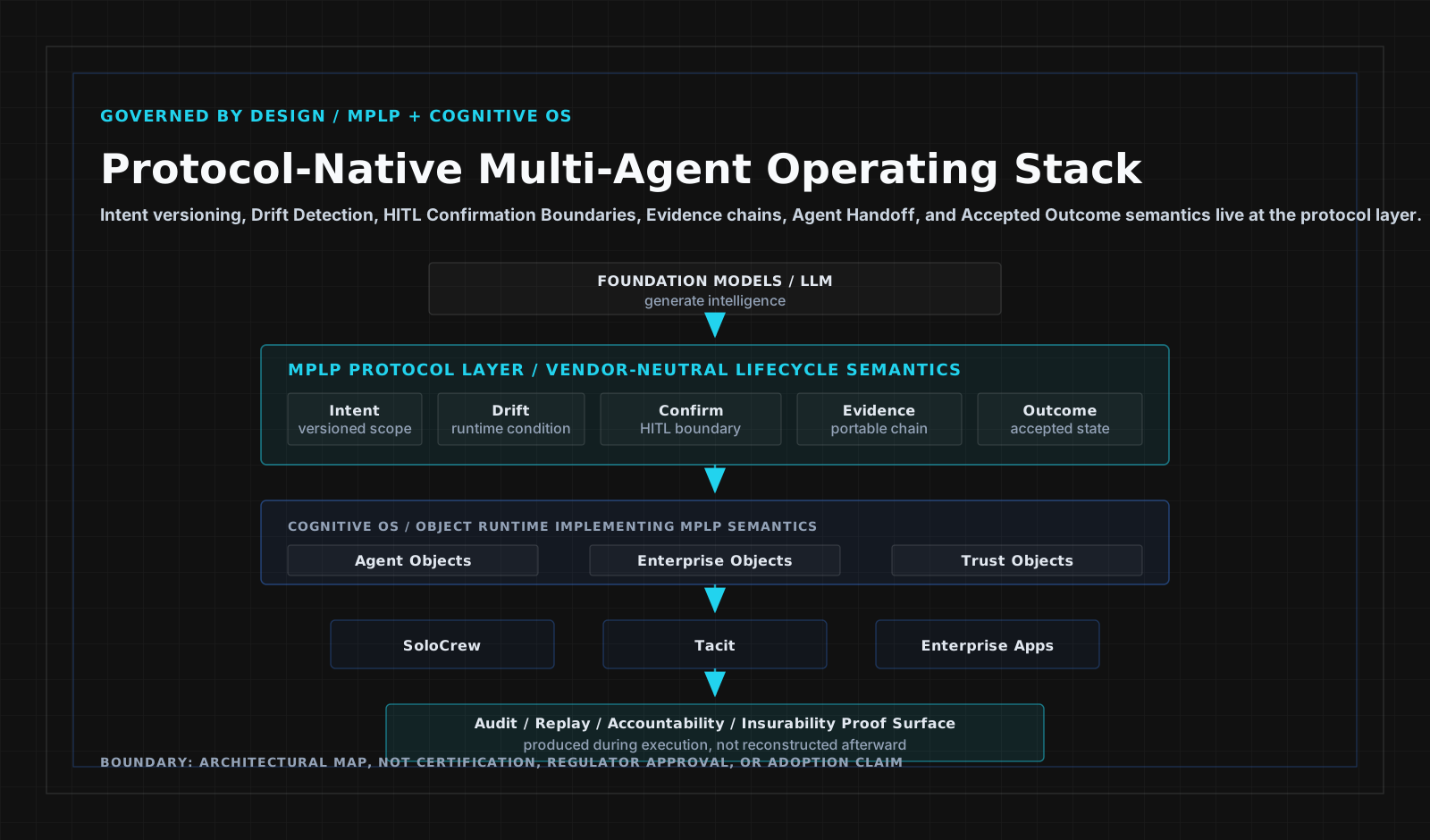
The coherence of this stack comes from a single property: the objects consumed by applications carry MPLP lifecycle semantics natively. A “Case” object in Cognitive OS is not only a business data structure. It can carry the Intent version under which it was created, the Confirmation Boundaries crossed, the EvidenceRecords produced, and the Responsibility Mapping that defines accountability. Applications do not reconstruct governance after the fact. They inherit it from the object layer.
The Three Object Layers of Cognitive OS
Cognitive OS, built on MPLP semantics, abstracts agentic work into three classes of objects that applications can directly consume, operate on, and track. This is not merely an object library. It is the objectification of work reality in the agentic domain.
- Company / Workspace
- Project / Goal
- WorkUnit / Task
- Thread / Cell
- Agent / HumanRole
- Decision / Budget
- Deliverable / Outcome
- Customer / Case
- Contract / Claim
- Review / Approval
- Risk / Policy
- Incident / Request
- Asset / Process
- Intent / Context / Plan
- ConfirmationBoundary
- EvidenceRecord
- TraceRecord / ReplayRecord
- ResponsibilityMapping
- AcceptedOutcome
- RemediationRecord
The first two classes make the platform useful to enterprises building AI-native applications. The third class explains why the platform can become structurally more trustworthy than a generic agent framework: every business object can carry lifecycle trust context as a native property, not as an externally appended log annotation.
Three Scenarios Where the Protocol Layer Changes the Outcome
Abstract architecture arguments eventually require concrete stakes. The following scenarios show how the presence or absence of a shared protocol layer changes not just system efficiency, but accountability and auditability.
A bank deploys three specialized agents: a pattern recognition agent on LangGraph, a risk scoring crew on CrewAI, and an alert routing agent connected to a compliance platform. At 14:32, a $4.7M transfer is initiated. The LangGraph agent flags an anomaly. The CrewAI crew elevates the risk score. The compliance platform generates a Suspicious Activity Report.
The transaction has already cleared. The "review required" flag was advisory in one system, not a binding constraint on the transaction lifecycle.
The same agents write to a shared MPLP Transaction lifecycle object. When the pattern recognition agent detects the anomaly, it sets risk_state = "elevated" on the protocol object. A Confirmation Boundary suspends execution until a human compliance officer confirms or remediates.
The lifecycle becomes a portable evidence pack: original Intent, EvidenceRecords, human confirmation timestamp, Responsibility Mapping, and AcceptedOutcome.
Key insight: a framework status can be advisory. A protocol Confirmation Boundary can become binding for every system that consumes the lifecycle object through a runtime implementing the protocol.
A manufacturer deploys legal, finance, and regulatory compliance agents for supplier contract review. Legal approves. Finance approves. The regulatory compliance agent then flags a sanctions concern, but the downstream procurement system has already interpreted the earlier statuses as final approval.
Post-incident, no system can identify a binding cross-agent veto right at the protocol layer.
All three agents write to a shared MPLP Contract lifecycle object. The AcceptedOutcome condition states that all three streams must be accepted and no elevated risk_state may remain before execution proceeds. The compliance flag creates a Confirmation Boundary requiring legal and compliance sign-off before execution.
The accountability chain is not reconstructed. It is read from the Responsibility Mapping.
Key insight: cross-agent veto rights cannot be reliably enforced by one framework alone. They require protocol-level AcceptedOutcome conditions that bind the lifecycle object.
A private equity firm runs six specialized agents for a $200M acquisition: financial statement analysis, legal filing review, IP assessment, market position analysis, management background checks, and regulatory approval analysis. Each produces a separate report and audit trail.
The investment committee cannot answer with precision when a significant risk was identified and whether it was escalated before the process continued.
All six agents contribute EvidenceRecords to a shared MPLP M&A lifecycle object. Each record carries the active Intent version. Any elevated risk_state triggers a Confirmation Boundary requiring senior partner sign-off before due diligence continues.
The final deliverable is a machine-readable evidence pack produced during execution, not a story reconstructed afterward.
Key insight: an evidence pack produced during execution is categorically different from a synthesized report compiled after the fact.
The Regulatory Dimension
Several regulatory and supervisory sources now ask organizations to reason about AI risk management, oversight, logging, explainability, accountability, and evidence. These sources do not endorse MPLP. They simply make the lifecycle evidence problem unavoidable.
- EU AI Act: high-risk AI obligations include risk management, record-keeping, logging, and human oversight requirements.[8]
- UK FCA: FCA AI materials emphasize safe and responsible adoption, evidence-based supervision, and accountability and governance under existing financial services rules.[9]
- MAS FEAT: Singapore's FEAT principles frame fairness, ethics, accountability, and transparency for AI and data analytics in financial services.[10]
- US model-risk supervision: SR 11-7 establishes expectations for model development, implementation, validation, governance, documentation, and controls.[11]
The common pattern is not that regulators are asking for MPLP. The pattern is that they ask for evidence that systems operated within defined boundaries, that humans had accountable oversight at defined points, and that decisions can be reproduced and attributed. Protocol-level lifecycle objects are one architectural answer to that evidence problem.
Strategic Implications for CIO, CISO, and Enterprise Architects
A protocol layer converts agentic AI governance from a per-project engineering problem into an infrastructure property. Every new deployment no longer needs to re-invent authority boundaries, HITL points, evidence capture, and acceptance criteria from scratch.
Platform guardrails are real controls, but their authority boundaries may not travel across framework boundaries. Protocol-layer authority objects make the cross-system question explicit: which runtime must enforce which boundary under which Intent version?
Cognitive OS extends enterprise object modeling into agentic work. The difference is not that it replaces enterprise platforms. The difference is that it makes lifecycle-native state part of the object itself: Intent, Confirmation Boundary, EvidenceRecord, ResponsibilityMapping, AcceptedOutcome, and RemediationRecord.
Capability Positioning: Protocol-Native vs Platform-Level
The comparison below distinguishes capability origin - framework/platform-level versus protocol-native - rather than making binary claims about whether a named platform has useful governance features. LangChain, CrewAI, and Palantir have real capabilities. The question is where the lifecycle semantics live architecturally.
| Capability Dimension | LangChain + LangSmith | Palantir AIP + Ontology | MPLP + Cognitive OS |
|---|---|---|---|
| Agent execution and orchestration | ✓ Framework-level | ✓ Platform-level | ✓ Protocol semantics plus runtime implementation |
| Observability and tracing | ✓ LangSmith traces | ✓ AIP audit logs and ontology events | ✓ EvidenceRecord and ReplayRecord objects |
| Human-in-the-loop | Framework-level | Platform-level | ✓ ConfirmationBoundary object |
| Cross-system authority boundaries | — Ecosystem-scoped unless integrated externally | — Platform-scoped unless integrated externally | ✓ Protocol primitive |
| Intent versioning and drift detection | Application pattern | Ontology-specific | ✓ Protocol state transition semantics |
| Multi-agent responsibility mapping | Framework-integrated if designed | Platform-integrated if modeled | ✓ Protocol object plus runtime state |
| Risk-evaluation evidence surface | — Trace input to risk review | — Audit log and object-state input | ✓ Lifecycle evidence objects produced during execution |
From Auditable to Risk-Evaluation Evidence Surface
LangSmith traces can tell you what an agent did. Palantir AIP logs can tell you what actions were taken by humans or AI agents. These are valuable audit capabilities. For post-incident review, regulatory examination, and organizational learning, they matter.
But for risk underwriting - the question an insurer or risk officer asks before an event, not after it - what matters is not only whether an incident can be reconstructed. It is whether the system’s risk profile is evaluable before execution begins: are risk boundaries observable during execution? Is control enforced at the protocol layer or only at the application layer? When a human confirms an action, do they confirm the Intent or a specific downstream action they may not have seen? Can losses be attributed to a specific agent, authority boundary, and Responsibility Mapping?
# Post-execution record (LangSmith / Palantir AIP)
event:      onboarding_approved
agent:      kyc-agent-v2
user:       reviewed
timestamp:  2026-06-07T10:14Z

# Cannot answer:
# - What was the authority boundary?
# - Was beneficial ownership ambiguity resolved?
# - What did the human actually confirm?
# - Who holds the Responsibility Mapping?
# - Was remediation closed or just flagged?
identity_eval:        verified
sanctions_signal:     clear
ownership_ambiguity:  detected
authority_boundary:   kyc_l2_required
confirmation:         human_required
responsibility:       kyc_officer@org
outcome_status:       accepted
remediation:          closed
# Onboarding blocked until ownership_ambiguity
# resolved — defined in protocol, not app code
The distinction is not between more logging and less logging. It is between a system that records what happened and a system that represents lifecycle semantics during execution, then produces evidence of that representation as portable protocol objects.
The Strategic Position
LangChain, CrewAI, and Palantir each have genuine and substantial capabilities. The gap is not quality. The gap is architecture: their public materials do not define a vendor-neutral protocol layer for agent lifecycle semantics as portable, cross-system, cross-framework primitives.
The market does not need another agent framework. It does not need another governance dashboard. It needs the missing protocol specification for how agentic work is authorized, confirmed, evidenced, accepted, and remediated across boundaries.
MPLP is that protocol-layer proposal. Cognitive OS is an Agentic-AI-native object runtime built on it. Together, they attempt the same type of architectural move that SWIFT made for interbank messaging, HTTP made for the web, and TCP/IP made for network communication: defining the shared protocol layer so the applications above it can be built with common semantics.
The foundation model generates intelligence. MPLP defines lifecycle rules beneath it. Cognitive OS turns that intelligence into usable, reliable, accountable work - not in a single framework, but across the enterprise.
References
- LangChain, "LangSmith: Observe, evaluate, deploy AI agents". Official LangChain platform page for LangSmith observability, evaluation, deployment, monitoring, human-in-the-loop support, and multi-agent coordination.
- LangChain Blog, "Introducing LangSmith LLM Gateway", 2025. Official blog post describing LLM Gateway as a runtime governance layer for policy enforcement during LLM calls.
- CrewAI, "CrewAI Documentation". Official documentation describing framework-native guardrails, memory, knowledge, observability, human-in-the-loop triggers, and callbacks.
- LangChain, "LangSmith Deployment". Official LangSmith platform material referenced for human-in-the-loop and multi-agent deployment capabilities.
- Palantir Blog, "Connecting Agents to Decisions". Official Palantir blog describing agent actions, human review workflows, guardrails, Ontology integration, and monitoring claims.
- Palantir Documentation, "AIP Overview". Official documentation positioning AIP, Foundry, and Apollo as an operating system for AI-powered workflows, agents, and enterprise functions.
- Palantir, "Ontology Platform". Official platform page describing Ontology objects, actions, security controls, and MCP exposure for external agents.
- European Union, Regulation (EU) 2024/1689. Official text of the EU AI Act, including high-risk AI obligations around risk management, logging, record-keeping, and human oversight.
- Financial Conduct Authority, "AI and the FCA: our approach" and "Artificial Intelligence (AI) update". FCA materials on safe and responsible adoption, evidence-based supervision, accountability, and governance.
- Monetary Authority of Singapore, "Principles to Promote FEAT in the Use of AI and Data Analytics in Singapore's Financial Sector". MAS principles for fairness, ethics, accountability, and transparency.
- Federal Reserve, SR 11-7: Guidance on Model Risk Management. Supervisory guidance on model development, implementation, validation, governance, documentation, and controls.
Continue from this record
Publication sequence
Related ideas
Recommended proof path
If you only follow one next step after the thesis, continue from MPLP to Cognitive OS.