There is a particular kind of conversation that repeats itself across enterprise AI right now. Someone uses the phrase “AI governance.” Someone else says “agent accountability.” A third person talks about “auditability” or “human-in-the-loop” or “runtime trust.” Heads nod. The problem feels understood. And then the meeting ends, and the agents keep running, and nothing structural has changed.
The words are right. The analysis is right. What’s missing is the layer.
This essay is about that missing layer — why it’s missing, what it actually is, and why I believe the correct response to the market’s current state of naming symptoms is not another framework or another governance slogan, but a protocol answer. That answer is Multi-Agent Lifecycle Protocol (MPLP).
The industry is describing the same failure in different vocabularies
Deloitte reported that AI agents are scaling faster than enterprise guardrails, with only 21% of surveyed enterprises reporting mature governance for agentic AI. Microsoft’s 2026 Work Trend Index found that even among agent-leading organizations, only about a quarter had agent workflows, human handoffs, and quality standards documented and repeatable at the organization level. Gartner projects that up to 40% of enterprise applications will include task-specific AI agents by 2026, up from less than 5% in 2025. The governance infrastructure is not keeping pace.
But the interesting thing is not the gap in readiness — that’s expected with any fast-moving technology. The interesting thing is the vocabulary being used to describe it. Depending on where you look, the problem is framed as:
AI governance. Runtime control. Agent auditability. Human-in-the-loop accountability. Agentic workflow assurance. AI insurability. Evidence chains. Operational trust. Algorithmic responsibility. Intent drift. Privilege drift. Broken delegation chains. The accountability gap.
Each of these terms is pointing at something real. And they’re all pointing at the same thing. The industry keeps renaming a single failure: that agentic AI systems can now act — through tools, APIs, workflows, databases, customers, vendors, downstream systems — but the enterprises running them cannot reliably reconstruct how a piece of work moved from human intent to accepted outcome under authority, evidence, responsibility, and remediation controls.
That failure has a name. I call it the absence of AI Agent Lifecycle Governance. And MPLP defines the lifecycle answer to it.
A category error at the foundation
Before defining what’s missing, it’s worth naming what I think is the foundational mistake.
People keep treating AI governance as one problem. It is not. There are at least two problems that operate at different layers and require different responses.
The first is LLM Lifecycle Governance: the governance of the model itself. Training data, alignment, evaluation procedures, safety behavior, deployment decisions, post-training modifications, internal controls. This layer belongs mostly to the labs and the regulators. For enterprise users, much of it remains structurally opaque. A company deploying a proprietary model does not have meaningful visibility into how that model was trained, filtered, updated, or internally evaluated. That’s going to become a serious regulatory issue — and likely a liability issue as the EU AI Act and similar frameworks mature. But it is not the problem most enterprises are actually able to solve right now.
The second is AI Agent Lifecycle Governance: the governance of agentic work at runtime inside real organizations. This is about what happens when an AI system stops being a responder and becomes an actor. It governs how human intent becomes agent action, what authority was delegated, which agent role executed, which tool changed the external world, what evidence existed at the time, whether the context was still valid, and whether the output was reviewed and actually accepted.
This second layer is enterprise-controllable. Even when the underlying model remains a partial black box, the lifecycle of agentic work built on top of it does not have to be ungoverned. The enterprise may not own the model. But it can own how work is authorized, executed, evidenced, reviewed, accepted, and remediated.
That distinction is where the market keeps losing the thread. LLM Lifecycle Governance governs the model. AI Agent Lifecycle Governance governs the work. MPLP is designed for the second layer.
LLM Lifecycle Governance vs AI Agent Lifecycle Governance
Orchestration is not governance
The current agent ecosystem has made execution easier. Agents can call tools, follow workflow graphs, route between nodes, pass memory, coordinate with other agents. The frameworks are proliferating. The tooling is improving. Companies can prototype multi-agent workflows in days.
But execution has never been the hard problem for enterprise governance. The hard problem is proof.
A routing graph does not prove authority. A trace does not prove responsibility. A log does not prove that the action was within scope. A human approval button does not prove that the right human role, under the right evidence, accepted the right outcome. A workflow completion event does not prove delivery.
Most agent frameworks answer one question: can the system execute the work?
Enterprise governance requires a harder question: can the organization prove how the work moved from intent to accepted outcome?
That distinction is where orchestration and governance split. Orchestration is infrastructure for execution. Governance is infrastructure for accountability. They are not the same thing, and building more of the first does not automatically produce the second.
This is why MPLP is not another orchestration framework. It is a lifecycle protocol.
The protocol defines agentic work as a governed chain: Intent → Context → Plan → Authority → Agent Role → Tool Action → Evidence → Confirm → Accepted Outcome → Remediation. Each object in that chain exists because a real governance failure appears when it’s absent.
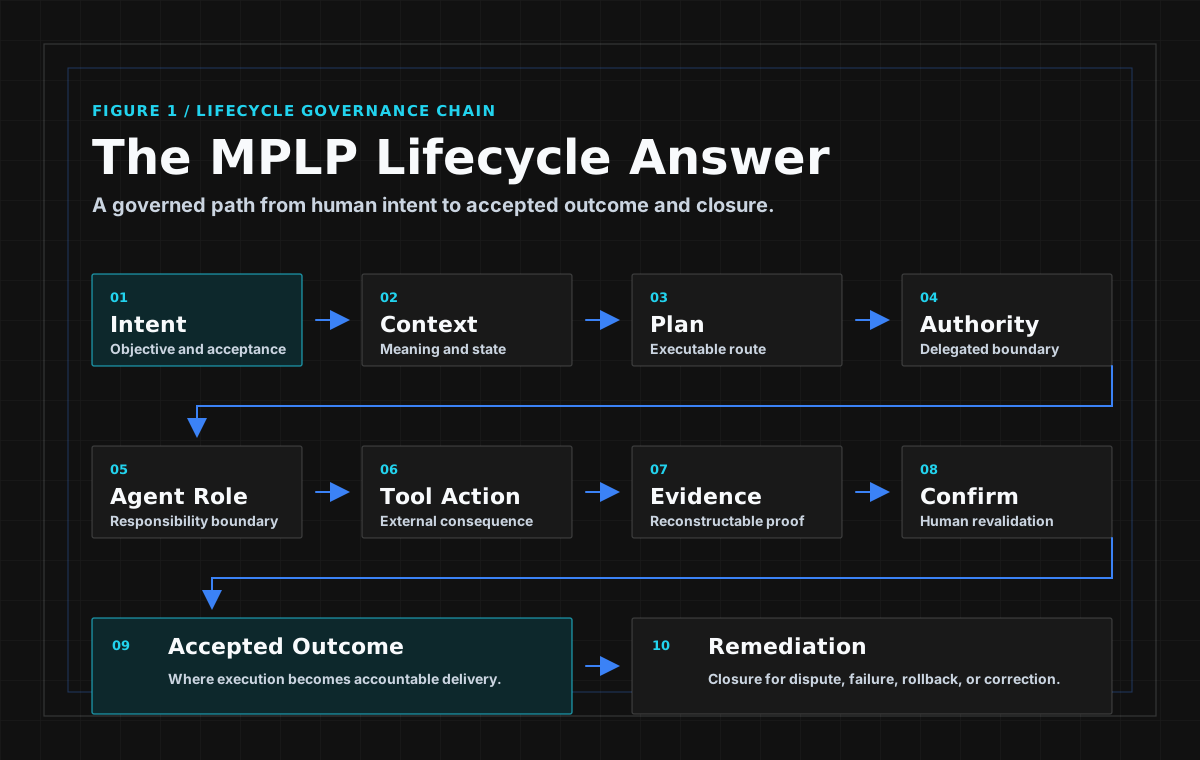
Without Intent, execution has no original reference point against which drift can be measured. Without Authority, tool access gets confused with business permission. Without Agent Role, personas get confused with responsibility boundaries. Without Accepted Outcome, task completion gets mistaken for delivery. Without Remediation, failure has no bounded closure. Without the full chain, the enterprise has automation — but not governable agentic work.
Market Symptom → MPLP Lifecycle Object
A protocol has to be vendor-free to function as a protocol
This independence matters more than it might first appear.
Most current approaches to agentic governance are structurally entangled with either a model provider or an agent framework. Governance features are bundled into a specific runtime. Audit trails are proprietary to a specific platform. Accountability semantics are tied to a specific vendor’s interpretation of what “human-in-the-loop” means. The moment an enterprise changes its LLM provider, migrates to a different orchestration framework, or runs agents across multiple vendors simultaneously, the governance layer either breaks or requires renegotiation from scratch.
MPLP is designed to be vendor-free in two dimensions.
The first is model-vendor independence. The lifecycle objects — Intent, Authority, Agent Role, Evidence, Accepted Outcome, Remediation — are defined at the protocol layer, not at the model layer. An enterprise can switch the underlying LLM, run multiple models across the same agentic workflow, or operate in a multi-provider environment, and the governance semantics remain stable. The lifecycle does not belong to the model.
The second is framework independence. MPLP does not require a specific agent framework, orchestration tool, or runtime environment to be operable. Its lifecycle objects can be implemented across LangGraph, AutoGen, CrewAI, custom pipelines, or enterprise-built systems. The governance layer sits above the execution layer — which is exactly where a protocol layer should sit.
This is what makes MPLP a protocol answer rather than another vendor-specific governance product. TCP/IP did not belong to any single network hardware vendor. POSIX did not belong to any single Unix implementation. A lifecycle governance protocol for agentic AI should not belong to any single model provider or agent framework. That independence is not a feature. It is the architectural requirement for a protocol to function as a protocol.
Why governance cannot arrive after execution
Most governance in enterprise AI still operates retrospectively. Logs are reviewed after incidents. Dashboards flag anomalies after they’ve occurred. Compliance reporting happens quarterly. Auditors ask for evidence after something breaks.
For slow-moving systems, deferred governance is annoying but tolerable. For agentic systems, it creates structural exposure.
An agent can act faster than a committee can review. It can pass work to another agent before a human understands what changed. It can call a tool before the governance team sees the drift. It can complete a workflow whose original intent was altered somewhere in the middle of execution. By the time the review happens, the external consequence has already landed.
The problem is not just speed. It’s the nature of the objects. An agentic system operates across time, across agents, across tool calls, across context updates, across partial information states. The relationship between the original intent and the final action can degrade through a series of small steps, none of which individually triggers an alert. This is what researchers and practitioners are increasingly calling “intent drift” — the accumulation of small deviations that, in aggregate, takes the system far from what was actually authorized.
Governing this requires something more than retrospective review. It requires lifecycle-native governance: a structure that tracks the relationship between the original intent, the current context, the delegated authority, the agent role, the tool action, the evidence state, and the accepted outcome — throughout execution, not only after it.
This is why Delta Intent, Project Semantic Graph, Value State Layer, and Action Execution Layer matter in the MPLP architecture. They are not theoretical elaborations. They are the runtime machinery of the lifecycle answer.
Delta Intent makes change explicit. It records when the original intent shifts, who authorized the change, what evidence supports it, and whether the plan or confirmation boundary must reopen. Without it, intent drift accumulates silently until the final output no longer matches what was ever actually authorized.
Project Semantic Graph preserves the meaning layer. It tracks the relationships among intent, context, plan, role, authority, evidence, and responsibility, so semantic drift can be detected before it becomes external consequence — before the system is acting on a version of the problem that no longer matches the version the human approved.
Value State Layer preserves the state layer. It stores versioned state, snapshots, evidence, decisions, and replayable history, so the system can compare the current execution state against prior valid states. This is what makes audit reconstruction possible after the fact, and what makes rollback possible before the damage compounds.
Action Execution Layer protects the consequence layer. It intercepts external action before it becomes real, asking whether the proposed action is still admissible under current intent, authority, evidence, and confirmation requirements. This is where governance stops being a policy and starts being a constraint.
Together, these components are the difference between observing execution and governing execution. Without them, you have observability after the fact — useful for investigation, insufficient for control.
Auditability is not the same as logs
One of the most common confusions in this space is treating logs as auditability. They are related, but they are not the same thing.
Logs record events. Auditability means that a person — an auditor, a regulator, an insurer, an internal reviewer, a customer — can reconstruct the lifecycle of the work: who owned the intent, who granted authority, which agent role acted, which tool was used, what evidence existed before the action, what changed during execution, who reviewed the result, whether it was accepted, and how failure was closed.
That reconstruction requires relationships, not just events. An audit log tells you that something happened. An audit evidence chain tells you whether that thing was authorized, responsible, reviewed, accepted, and recoverable.
The current state of most agentic systems is that they are observable but not audit-ready. They can show you what the agents did. They cannot reliably answer whether those actions were within scope, properly authorized, executed under still-valid context, and accepted by the right parties under the right evidence.
This is why MPLP treats Trace, Confirm, Accepted Outcome, and Remediation Closure as first-class lifecycle objects — not as features to be added later, but as structural requirements for auditability to exist at all.
Insurance exposes the weakness of vague governance language
If you want to understand where governance language breaks down, look at insurance.
People increasingly ask whether AI agents can be insured. The question is usually framed around risk and liability. But before the question of pricing gets anywhere, there is a prior question that has to be answered: what is the insurable object?
The model? The agent? The company? The workflow? The tool action? The accepted outcome? The failure event? The remediation process? If the risk object is not identifiable, bounded, observable, attributable, and evidenced, there is nothing stable to underwrite. You cannot price a distribution of outcomes when you cannot define the unit of risk.
This is the concrete version of a problem that sounds abstract in governance discussions. Insurance requires actuarial structure. Actuarial structure requires a defined risk object with observable states, bounded authority, traceable actions, and closed remediation. That is exactly the lifecycle object structure that agentic systems currently lack.
MPLP addresses this not by adding an insurance module, but by defining the objects that make underwriting structurally possible: Delegated Authority Boundary, Tool-Action Liability Boundary, Human Role to Agent Responsibility Mapping, Evidence Chain, Accepted Outcome, and Remediation Closure. Without these objects, insurers have no stable handle on agentic risk. With them, the conversation can at least begin.
The posture I am not taking
Before describing what MPLP is, I want to be precise about what it is not, and what posture I am not taking.
I am not claiming that MPLP already holds the position that TCP/IP holds in networking, or that POSIX holds in operating system portability. Those standards earned their authority through decades of implementation, adoption, compatibility testing, standardization body validation, and ecosystem maturity. MPLP is not at that stage.
What I am claiming is something narrower and, I think, more useful: that MPLP is attempting the same kind of move that TCP/IP made for internetworking and POSIX made for operating system portability — not adding another product, but defining the missing layer that makes a fragmented ecosystem governable.
The current fragmentation in agentic AI governance is not primarily a tooling problem, a policy problem, a dashboard problem, or a framework problem. It is a missing-layer problem. The layer that’s missing is a lifecycle protocol that can express agentic work from intent to accepted outcome in a way that is governable, auditable, evidenced, recoverable, and eventually insurable — and that can do so across any model, any framework, any vendor, and any runtime environment.
The market is not short of frameworks. It is not short of governance slogans. It is short of a lifecycle interface layer with consistent governance semantics. That is what MPLP defines. Whether it will achieve the adoption and validation required to hold a POSIX-level position is a question for implementation, testing, and time. But the type of move — defining the missing layer rather than adding another product — is the same.
The discussion the market should now have
There was a period when debating whether AI agents needed governance was a reasonable thing to do. That period is over. The market has already answered it by accumulating the failures, fragmentation, accountability gaps, and audit liabilities that are now showing up in production environments across industries.
The useful conversation now is different. It is not: should agentic systems be governed? It is: does the proposed lifecycle protocol define the right objects? Does it draw the right boundaries? Does it handle authority drift? Does it separate completion from accepted outcome? Does it survive multi-agent handoffs? Does it work across frameworks, vendors, and runtime environments? Does it give auditors, insurers, regulators, and enterprise architects a shared language for agentic work?
Those are the questions MPLP now invites.
The protocol is not finished. It should be tested, challenged, criticized, extended, and improved by engineers, auditors, security architects, compliance teams, legal practitioners, and enterprise operators. That process of evaluation is not a detour from the work — it is the work.
So the invitation is direct. Read it. Test it. Challenge it. Implement against it. Map your agent system to its lifecycle objects. Try to break it. Show where the authority, evidence, accepted outcome, or remediation semantics need to be sharper. Show where the chain is incomplete. Show where a real production system exposes gaps that the protocol does not yet handle.
That is how a protocol answer matures. Not through another round of vague agreement that AI governance matters. Through implementation pressure, criticism, compatibility testing, and evidence from real systems.
That is where I believe the market is now.
The problem has been named often enough. Fragmentation, weak accountability, non-auditability, non-insurability, and non-replayability are not separate complaints. They are symptoms of the same missing layer.
I define that layer as AI Agent Lifecycle Governance.
I have abstracted it into MPLP — Multi-Agent Lifecycle Protocol.
The next serious conversation should not be whether agentic AI needs governance. That has already been answered by the failures now appearing in production systems.
The next conversation should be whether this lifecycle answer is precise enough to test, implement, criticize, adopt, and improve.
That is the work ahead.
And that is what MPLP is for.
Jearon Wong is the author of MPLP — Multi-Agent Lifecycle Protocol, a lifecycle governance framework for enterprise agentic systems.
Continue from this record
Publication sequence
Related ideas
Recommended proof path
If you only follow one next step after the thesis, continue from MPLP to Cognitive OS.